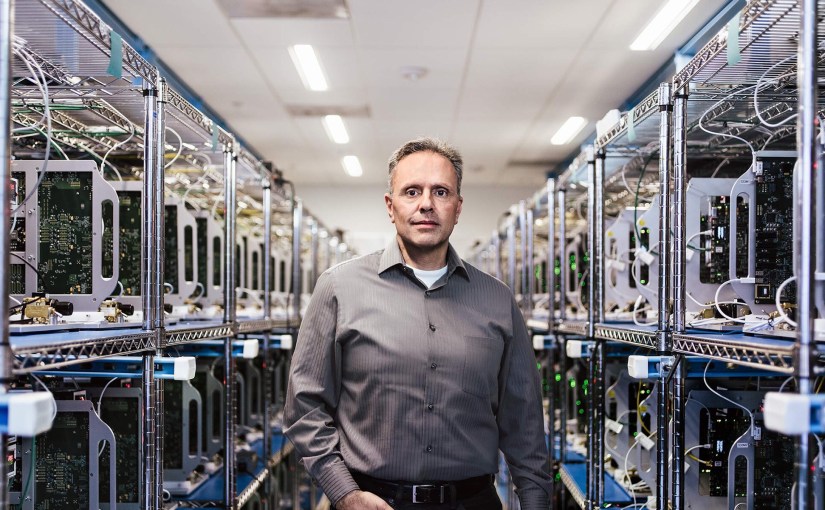
At the center of all this is Srouji, 51, an Israeli who joined Apple after jobs at Intel and IBM. He’s compact, he’s intense, and he speaks Arabic, Hebrew, and French. His English is lightly accented and, when the subject has anything to do with Apple, nonspecific bordering on koanlike. “Hard is good. Easy is a waste of time,” he says when asked about increasingly thin iPhone designs. “The chip architects at Apple are artists, the engineers are wizards,” he answers another question. He’ll elaborate a bit when the topic is general. “When designers say, ‘This is hard,’ ” he says, “my rule of thumb is if it’s not gated by physics, that means it’s hard but doable.”
Author: Edouard Chazal
You Might Go Bankrupt If Your Next-Door Neighbor Wins the Lottery
Why would someone winning the jackpot cause someone living down the street to go bankrupt a year or two later? The economists argued that people who feel they are poorer than their peers may spend more in a conspicuous fashion, financing their purchases with debt. But that debt will need to be repaid, potentially leading to financial difficulties and even bankruptcy.
Why Not Just Print More Money?
The best alternative, Turner thinks, is his radical proposal—creating money and handing it out to entities that can spend it. He readily concedes that it wouldn’t matter much whether the newly minted money was forwarded to households in the form of bank credits, or used to finance tax cuts, or spent on building new roads and bridges. The key point is that the government would be stimulating the economy without issuing any new debt. It wouldn’t be accentuating the problem of debt overhang, or creating the conditions for yet another boom-and-bust cycle.
Eagles of Death Metal Deliver Rock’n’Roll Catharsis in Paris
As the first chords rang out and fans on crutches let out a rousing cheer alongside hundreds of other survivors and relatives of the dead, it was clear that Paris was looking for a moment of rock’n’roll catharsis.
Finding Beauty in the Darkness
Too often people ask, what’s the use of science like this, if it doesn’t produce faster cars or better toasters. But people rarely ask the same question about a Picasso painting or a Mozart symphony. Such pinnacles of human creativity change our perspective of our place in the universe. Science, like art, music and literature, has the capacity to amaze and excite, dazzle and bewilder. I would argue that it is that aspect of science — its cultural contribution, its humanity — that is perhaps its most important feature.