Out in my garden in the Parisian suburb, tending to the in-ground plants and flowers, the reality of growth is always inescapable: it is quiet, it is slow, and it demands absolute consistency. Watering the earth over a weekend doesn’t yield a sudden, miraculous bloom by Monday. Growth operates on its own stubborn timeline, requiring a profound trust in the unseen. This intrinsic law of nature is something we intuitively understand when our hands are in the dirt, yet we routinely forget it when it comes to building our own lives, character, and capital.
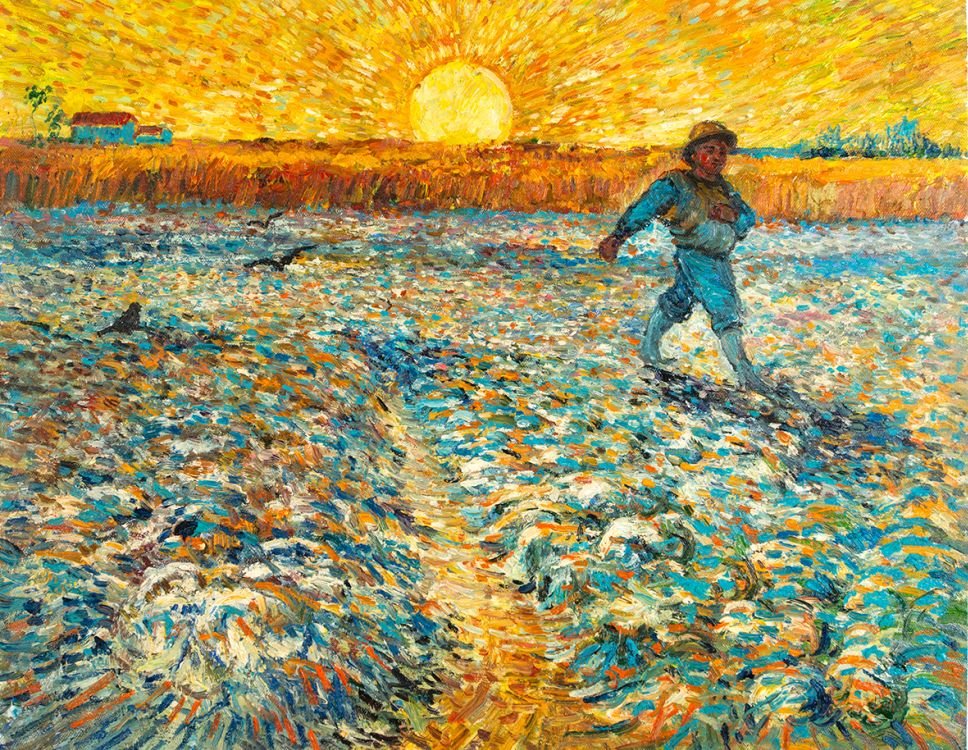
Vincent van Gogh captured the brutal, beautiful essence of this delayed gratification in his 1888 painting, The Sower. Against a sprawling, luminous, almost overwhelming sun, a solitary figure strides across a plowed field, casting seeds into the earth. The sower isn’t looking at a harvest; his eyes are on the mud. The painting doesn’t romanticize the reward, but rather elevates the routine itself. Sowing is an act of profound faith and deliberate, repetitive action. The sower is trading today’s energy for tomorrow’s potential, acting as an investor in a future he cannot yet see.
This agricultural reality mirrors an immutable spiritual and practical law. In his message The Power of Your Daily Routine, Pastor Craig Groeschel breaks down the architecture of our habits through the biblical principle of sowing and reaping, anchored in the Book of Galatians. By examining the spiritual physics of the harvest, we uncover the true engines behind any outsized success—and the agonizing mechanics of rebuilding a life.
First, you reap exactly what you sow. The input strictly dictates the output. The Apostle Paul writes in Galatians 6:7, “Do not be deceived: God cannot be mocked. A man reaps what he sows.” I know this not just as an abstract theory, but as a lived, painful reality. There were seasons of my life where my daily routines were wired for escape rather than endurance. I was consistently sowing the wrong things, trading my long-term baseline for short-term relief. I learned the hard way that you cannot plant seeds of self-destruction and expect to harvest peace, clarity, or prosperity. The earth, much like God’s divine order, returns exactly the nature of what it is given.
Second, you reap more than you sow. This is the principle of asymmetric, abnormal returns. A single seed does not yield a single seed; it produces a stalk bearing dozens. Jesus spoke of this exponential multiplier in Mark 4:8, describing seed that fell on good soil: “It came up, grew and produced a crop, some multiplying thirty, some sixty, some a hundred times.” In finance, we call this compound interest. In life, it’s the exponential power of atomic habits.
I have felt the crushing, suffocating weight of negative compounding firsthand. A single destructive habit doesn’t stay isolated; it multiplies, demanding more and more of your life until you are entirely bankrupt. But the beautiful, redeeming flip side is equally true. When you finally change the seed, the positive compounding begins. The daily reading of a few pages, the quiet refusal to give in to an old impulse, or the simple act of showing up compounds into a harvest that vastly outweighs the grueling daily cost of the transition.
Finally, you reap after you sow. This is the holding period, and it is the most dangerous phase of any turnaround. There is a necessary, intensely frustrating gap between the effort and the outcome. When you are desperately trying to break a dark cycle and wire a new way of living, the delay between your effort and your result is agonizing. You walk out under the blazing sun, make the hard, right choices day after day, and your field still looks entirely barren. The mental and physical toll of the waiting period screams at you to give up and return to what is easy.
It is here that Galatians 6:9 provides the ultimate mandate for the sower: “Let us not become weary in doing good, for at the proper time we will reap a harvest if we do not give up.” Our culture demands immediate dividends, but real change, true wealth, and deep, lasting recovery are formed entirely in the waiting.
Building abnormal capital—whether financial, intellectual, or spiritual—requires us to fall in love with the routine of the sower. We have to learn to find deep, abiding meaning in the mundane, difficult act of casting the right seed, trusting that if we master our daily habits and refuse to grow weary, the harvest is already guaranteed.