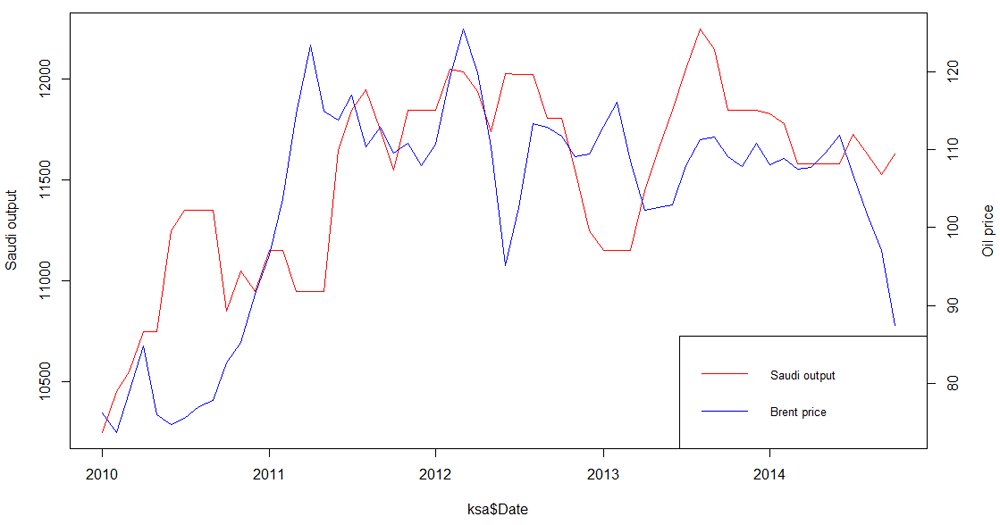
Why Oil Prices Came Down, And Won’t Anymore

Historically, Saudi Arabia has played a stabilizing role in world oil prices, by adjusting its output to ensure global supply is stable. The above graph show how Saudi output increased to lower prices when they were high, and vice versa. However, since July, the Saudis have not responded to newly low oil prices by decreasing output. In fact, the Kingdom have insisted that they would rather bear lower oil prices than decrease their market share (read: be squeezed out by shale).

→ Stats Life

Another Reason We Don’t Apply the 80-20 Rule

You’ll get one more reason by clicking the link down below :

The 80-20 rule sounds too good to be true. If 20% of inputs are so much more important than the others, why don’t we just concentrate on those? In an earlier post, I gave four reasons. These were:

  1. We don’t look for 80/20 payoffs. We don’t see 80/20 rules because we don’t think to look for them.
  2. We’re not clear about criteria for success. You can’t concentrate your efforts on the 20% with the biggest returns until you’re clear on how you measure returns.
  3. We’re unclear how inputs relate to outputs. It may be hard to predict what the most productive activities will be.
  4. We enjoy less productive activities more than more productive ones. We concentrate on what’s fun rather than what’s effective.

→ John D. Cook

The IMF’s Big Greek Mistake

Ultimately, the authorities’ approach merely replaced one problem with another: IMF and official European loans were used to repay private creditors. Thus, despite a belated restructuring in 2012, Greece’s obligations remain unbearable — only now they are owed almost entirely to official creditors.

→ Bruegel

And in This Corner… Fear

A writer has to be a fighter at heart, to deal with the failures and the rejections, and like a fighter, he’s going to lose some, but he’s got to keep going. Whatever the job, whatever the pursuit, there will be moments when you taste some leather. The more you care, the more it hurts. The fighter’s way of laying in the training and converting the pain into motivation is universal. And when it gets hard, when the idea of quitting might start to glow like a lantern in the distance on a dark night, it inspires me to remember that if my grandfather could do what he did that night in the Garden, then I can at least try my damndest to answer the bell in my own way.

→ The Art Of Manliness

Blue Period: Analyzing the Color of Paintings with R

The image above shows the color spectrum of almost 100,000 paintings created since 1800.

In an article for Significance magazine, Martin suggests a few possible reasons why paintings are getting bluer with time:

  • The colour blue is a relatively new colour word.
  • An increase in dark colours or black might drive the effect if these contain more blue or if the camera register them as blue to a larger extent.
  • The colours in paintings tend to change over time, e.g. due to the aging of resins.
  • Blue has historically been a very expensive colour, and the decreasing price and increased supply might explain the increased use.

→ R-Bloggers