Risky Business

Wishing all the best to the next endeavors.

David Sparks :

My other option was to leave my regular paycheck and health benefits behind and jump into the chaos that ensues from running a smaller, solo attorney law practice and (in my case) a book & video publishing business. I could serve just my clients with my own, smaller law practice and do things a bit more on my terms.

→ Mac Sparky

The Anti-Information Age

Myself, I sometimes think that I’d gladly censor what’s coming out from the tubes — what you get access to can be so depressing and conflicting with our own beliefs.

No place shows the contradictions of this contest on as grand a scale as China does. The country with the most Internet users and the fastest-growing connected population is also the world’s most ambitious censor. Of the 3 billion Internet users on the planet, 20 percent live in China (10 percent live in the U.S.). The government maintains the “Great Firewall” to block unacceptable content, including foreign news sites. An estimated 2 million censors police the Internet and the activities of users. Yet a 2014 BBC poll found that 76 percent of Chinese reported feeling free from government surveillance. This was the highest rate of the 17 countries surveyed.

→ The Atlantic

The Epidemic of Facelessness

The Gyges effect :

When the police come to the doors of the young men and women who send notes telling strangers that they want to rape them, they and their parents are almost always shocked, genuinely surprised that anyone would take what they said seriously, that anyone would take anything said online seriously. There is a vast dissonance between virtual communication and an actual police officer at the door. It is a dissonance we are all running up against more and more, the dissonance between the world of faces and the world without faces. And the world without faces is coming to dominate.

→ The New York Times

The NYTimes Could Be Worth $19bn Instead Of $2bn

IMG_1358

Frédéric Filloux :

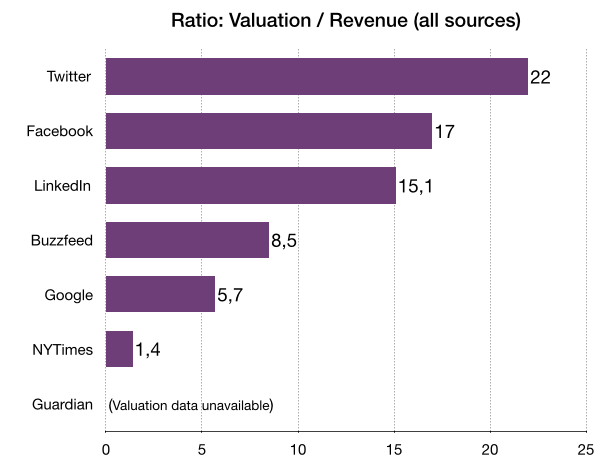
Through this lens, if Wall Street could assign to The New York Times the ratio Silicon Valley grants BuzzFeed (8.5 instead of a paltry 1.4), the Times would be worth about $19bn instead of the current $2.2bn.

Again, there is no doubt that Wall Street would respond enthusiastically to a major shrinkage of NYTCo’s print operations; but regardless of the drag caused by the newspaper itself, the valuation gap is absurdly wide when considering that 75% of BuzzFeed traffic is actually controlled by Facebook, certainly not the most reliably unselfish partner.

While BuzzFeed relies on ridiculous headlines and traffic from Facebook, investors are more inclined to value BuzzFeed way higher than the Times because of the potential it can generate in the future.

On the other hand, the Times is a safe-house, which proved to be realistic 5-7 years ago by transitioning into a successful digital brand. So all in all, the growth of Times is less tangible than a relatively new website. That’s precisely why there’s such a gap between the two. Though to be perfectly realistic, considering that one is kinda overvalued and the other one undervalued (in Silicon Valley standard) these two ratios should adjust and get closer together.

→ Monday Note

How The New York Times Works

Dive into the making and delivery of the most influential print newspaper and digital news site in the world :

Booth got here at 4 p.m. and will work until the last truck leaves. “Sometimes we’ll get out at 3, sometimes we’ll get out at 7,” he says. “You’re dealing with night people—we’re vampires here.” Tomorrow morning, most readers will think nothing of the fact that the paper was at their door at the same time yesterday and the day before that and the day before that. They may also think nothing of the fact that, at the moment they bend down to pick it up, some of the stories in the print version have already been updated on their phones and tablets, and new stories have been added, too: the score of a double-overtime game that ended too late, or news out of India that broke overnight. And all of these stories, the total daily and nightly output from all the desks at the Times—news from Washington and Ukraine and Sacramento and St. Louis and Staten Island and Mexico City, reviews of movies that open tomorrow and of TV shows that aired last night, opinion pieces, recipes, weekly sections on home design and science and real estate and style and books—feed a larger world of news that never stops consuming. The growing universe of digital news outlets includes a great many amalgamators, recyclers of other people’s reporting. Some report their own stories, but it is the Times that provides by far the most coverage of the most subjects in the most reliable way. The Times is a monster, a sprawling organization, the most influential print newspaper and digital news site in the world.

→ Popular Mechanics