Art: Pre-capitalist conspicuous waste?

Felix Salmon :

That’s real money, which, in a working capitalist economy, can and should be spent on productive assets. Instead, it’s being spent on utterly unproductive assets: billions and billions of dollars a year are going, in the name (at least partially) of “investment”, into paintings by long-dead artists. If rich people stopped paying billions of dollars for each others’ art, and started spending that money in the real economy, that would create jobs, growth, and even opportunities for working artists.

→ Medium

Most

We go visual today :

The “most” customers others are chasing are fickle and ultimately worth little to a young business just getting started. They might give you money in the short term, but then they move on to other things. They don’t sell your products to the next five customers. They just drop you as soon as another shiny object passes by.

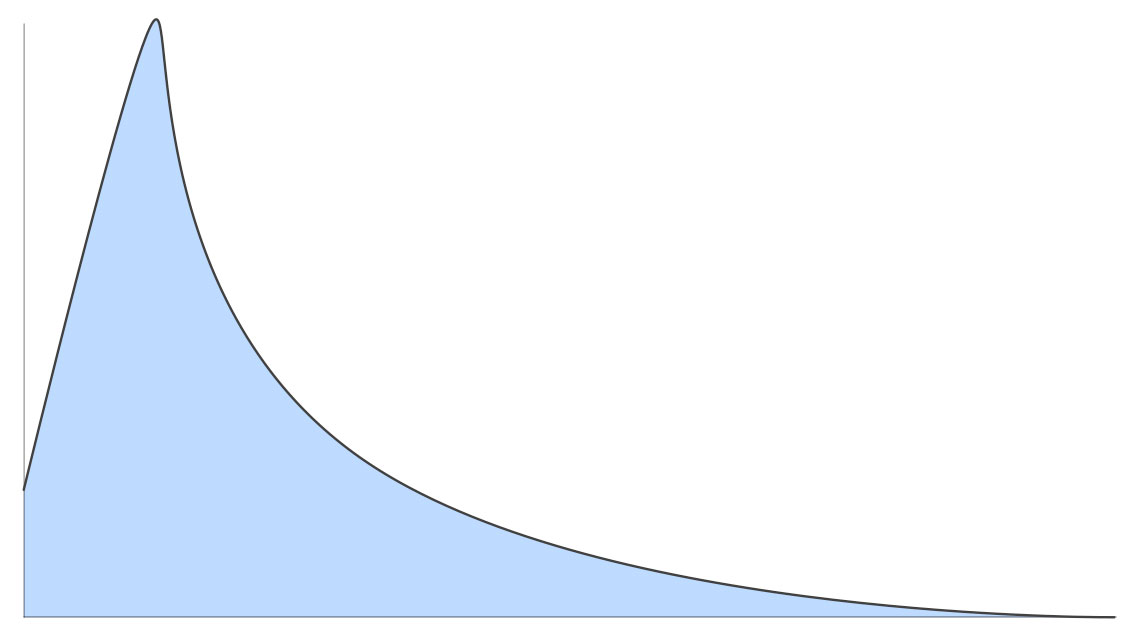
Chasing “most” gets you a sales chart like this:

saleschart1

Instead of a chart like this:

saleschart2

→ Joe Cieplinski

What Happened When Marissa Mayer Tried to Be Steve Jobs

“In many ways, Yahoo’s decline from a $128 billion company to one worth virtually nothing is entirely natural. Yahoo grew into a colossus by solving a problem that no longer exists. And while Yahoo’s products have undeniably improved, and its culture has become more innovative, it’s unlikely that Mayer can reverse an inevitability unless she creates the next iPod. All breakthrough companies, after all, will eventually plateau and then decline. U.S. Steel was the first billion-dollar company in 1901, but it was worth about the same in 1991. Kodak, which once employed nearly 80,000 people, now has a market value below $1 billion. Packard and Hudson ruled the roads for more than 40 years before disappearing. These companies matured and receded over the course of generations, in some cases even a century. Yahoo went through the process in 20 years. In the technology industry, things move fast.”

→ The New York Times

Why Are Commodity Prices Falling ?

In fact, there are four channels through which the real interest rate affects real commodity prices (aside from whatever effect it has via the level of economic activity).

First, high interest rates reduce the price of storable commodities by increasing the incentive for extraction today rather than tomorrow, thereby boosting the pace at which oil is pumped, gold is mined, or forests are logged.

Second, high rates also decrease firms’ desire to carry inventories (think of oil held in tanks).
Third, portfolio managers respond to a rise in interest rates by shifting out of commodity contracts (which are now an “asset class”) and into treasury bills.

Finally, high interest rates strengthen the domestic currency, thereby reducing the price of internationally traded commodities in domestic terms (even if the price has not fallen in foreign-currency terms).

→ Project Syndicate