Art: An Alternative Asset Wealth Managers Can Do Without

“Making money is art,” Andy Warhol once wrote :

Another reason for advisers’ hesitance is the unique due diligence skillset that art fund investments require. Investors must evaluate the fund’s financial structure and its investment potential. Wealth managers can readily grasp the finance projections, but few are equipped to gauge the fund manager’s art market expertise, proposed acquisition market or strategy for buying and selling profitably, Beard notes.

→ Institutional Investors

The Art World’s Biggest Lie: A Dealer Apologizes for Collecting as Investing

Adam Lindemann :

Just over the horizon was a whole new group of people who would change the game. Appearing as if from nowhere, like a biblical swarm of locusts: The art advisors. When I wrote my collecting book, there were just a few of them, influential and very knowledgeable, so I included some (Mark Fletcher, Thea Westreich, Sandy Heller among them). But, in the last few years, advisorshave popped up literally everywhere and now outnumber collectors 2 to 1. There are almost as many of them as yoga instructors.

The art-advisor phenomenon is a direct result of the change in the way buyers view their art buying. Today, the “collecting” audience no longer needs to be convinced their money is being well spent; they have bought into the art-as-investment thesis hook, line and sinker. So, in the same way you hire an investment advisor to manage your portfolio, and a management consultant to streamline your business, you now must hire an advisor to help you decide what art to “invest” in.

Gone are the days of “I simply must have it,” today there are two serious types of buyers. The mega art buyers who want international trophy art, who have no budget limit and only want the artistic equivalent of oceanfront property. Then there’s the hot money players: Wise guys, hooligans and celebrities. They go for what’s hot, what’s going to make them look smart and make them fast money.

Credit : Hanna Barczyk

→ The Observer
The Art Market: Impact of Weakening Chinese Economy

‘Girls in the Windows, New York’ (1960) by Ormond Gigli

Inevitably, all conversations in China turned to its weakening economy and whether this would affect the art market. Dealers tended to be upbeat though, according to collector Qiao Zhibing, the market has slackened: “Before the slowdown, buyers would have ‘definitely want’ and ‘maybe’ pieces and buy both; now they only buy the ‘definite’ ones,” he said. However, he added: “The rising middle class is interested in art and will buy to decorate their homes, and this will grow the market here”.

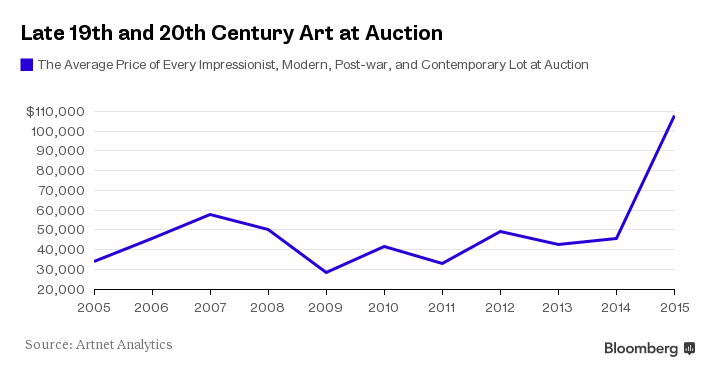
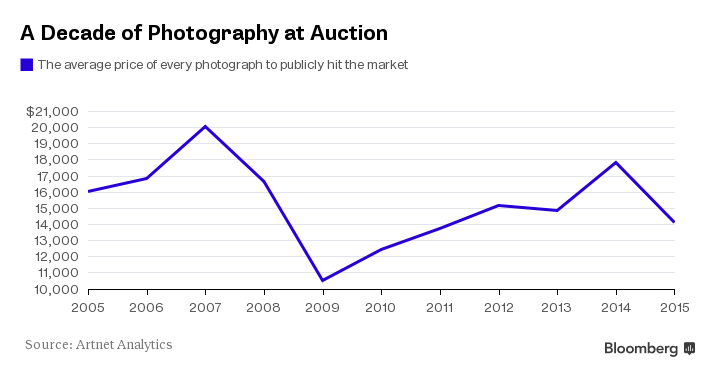
Big buyers will still be focused on ultra high-end paintings (the big uptrend of 2015 was mainly driven by a few unprecedented sales), while less prominent buyers might have a closer look into photographs as soon as the Chinese turmoil eases. Prices will certainly surpass previous tops when buyers will be more educated about the inner value of photography: cheaper and timeless, while less complex than modern art.

I’m wondering if the average price of paintings will be sustained in the coming years : Will there be as many impressive lots ? Will this lack of liquidity in the high-end inflates lower, fairly priced works ? Will there finally be a move into photographs ?

The fact that prices may at least stay flat, or fall in a context of moderate economic growth would not be unsurprising but it is the sign that prices in the market will move closer to home, at a less inherently speculative level.

→ The Financial Times

Is Photography the Best Deal in the Art Market?

From this vantage point, nope.

But I don’t think comparing both (a bubble and a niche market, except for a few odds like this expensive piece of sheet) makes much sense right now.

But to be fair, price irrationality isn’t the only factor for this asymmetry : a 19th-20th century painting is obviously more valuable then any photography will ever be.
So my guess is that to compare both mediums fairly, you need to be equally unfair, like this Bloomberg report, and reverse periods : the old masters of photography from the first half of the 20th (HCB, Klein, Brassaï) against 21th century contemporary painters.

Maybe that would help, maybe not —Chinese painting is quite expansive while worth it.


→ Bloomberg

Secret Art Storage Facilities Under Scrutiny

Don’t hate the player, hate the game.

Oligarchs cannot be blamed for being extra-opportunistic anyway.
That said, art has been commoditised for too long without being properly regulated.

Nearly a third of art collectors and professionals surveyed last year by Deloitte Touche Tohmatsu Ltd. said they had used a freeport. Experts speculate that the freeport in Geneva, which traces its roots back to 1854 and is controlled by local authorities, may house the most valuable art collection in the world—although its holdings are generally secret.

Someone interested in laundering money could arrange to use ill-gotten funds to purchase a painting inside of a freeport, Mr. Palmer said, and then resell the painting inside of the facility a few months later. Experts say it can be difficult for a customs official relying on a printed summary of a sale conducted inside a freeport to know for sure if the amount exchanged was appropriate, or if a painting that was purportedly sold was real.

→ The Wall Street Journal