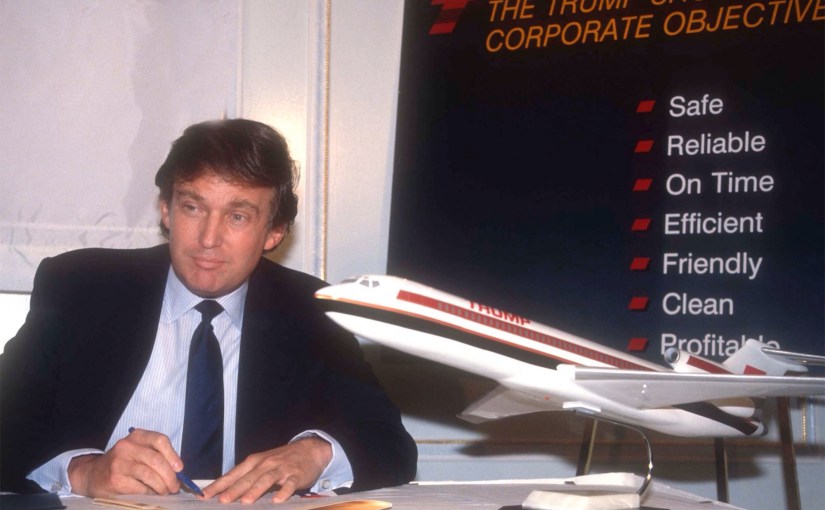
The Crash of Trump Air

“The bathroom was a work of art,” joked Nick Santangelo, who ran maintenance and engineering at the shuttle. “They used ideas from the hotel business, which wasn’t bad, but they didn’t always work.” Older jets in particular guzzle fuel and airline executives are obsessed with saving even a few ounces of weight. Not so Trump: “At first they wanted to put in a ceramic sink, that was too heavy,” said Santangelo. “Then one of his henchman decided they were going to put brass handles on the doors you use to get out in an emergency. Normal handles weigh a few ounces, and these things probably weighed five pounds each… you’d kill to save one pound, and they wanted to add 20 to 30 pounds to each plane.”

→ The Daily Beast

America : The Sticky Superpower

One of the oddities of globalisation is that although America’s trade footprint has shrunk, its monetary footprint has not. The Federal Reserve is the reluctant master of this system, its position cemented by the policies put in place to fight the 2007-08 financial crisis. When the Fed changes course, trillions of dollars follow it around the world. America’s indifference towards the IMF and World Bank, institutions it created to govern the system and over which it has vetoes, reflects power through neglect.

→ The Economist

How $1bln Evernote Went From Silicon Valley Darling to Deep Trouble

Depending on where you stand, Evernote is either a sinking ship or a maturing company going through a normal transition cycle. But most people we spoke to seem to agree that the company has failed to take advantage of its red-hot growth and make enough money from much of its huge user base — and is starting to show early signs of being an ailing unicorn.

It’s a sobering reality check about the business challenges that can derail even the hottest tech sensations.

I am fed up of Evernote. Iterations after iterations, their apps are clunky as ever.
But to be fair, all other services of this kind (OneNote, Quip…) are worse.
So I am stuck with Evernote, anyway.

→ Business Insider

The Art World’s Biggest Lie: A Dealer Apologizes for Collecting as Investing

Adam Lindemann :

Just over the horizon was a whole new group of people who would change the game. Appearing as if from nowhere, like a biblical swarm of locusts: The art advisors. When I wrote my collecting book, there were just a few of them, influential and very knowledgeable, so I included some (Mark Fletcher, Thea Westreich, Sandy Heller among them). But, in the last few years, advisorshave popped up literally everywhere and now outnumber collectors 2 to 1. There are almost as many of them as yoga instructors.

The art-advisor phenomenon is a direct result of the change in the way buyers view their art buying. Today, the “collecting” audience no longer needs to be convinced their money is being well spent; they have bought into the art-as-investment thesis hook, line and sinker. So, in the same way you hire an investment advisor to manage your portfolio, and a management consultant to streamline your business, you now must hire an advisor to help you decide what art to “invest” in.

Gone are the days of “I simply must have it,” today there are two serious types of buyers. The mega art buyers who want international trophy art, who have no budget limit and only want the artistic equivalent of oceanfront property. Then there’s the hot money players: Wise guys, hooligans and celebrities. They go for what’s hot, what’s going to make them look smart and make them fast money.

Credit : Hanna Barczyk

→ The Observer