Instead of trying to identify profitable trading algos on in-sample data that validate out-of-sample and remain profitable forward, one could instead try to identify unprofitable algos in some data sample that turn profitable in a forward sample. This often works because markets have become more mean-reverting in recent years.
Category: Economics
Greek Parallel Currency: How to Do it Properly
The TCC avenue would clearly be a superior solution, and would allow Greece to stayin the Eurozone, while stimulating demand by increasing citizens’ purchasing power, reducing domestic labor costs, and significantly increasing GDP. This would also generate, in due course, higher gross tax receipts (which would offset the shortfall in euro fiscal revenue due to TCC issuance).
Who Is Saudi Arabia Really Targeting In Its Price War?
Follow-up on the previous article, this one from Arthur Berman for Naked Capitalism :
Prolonged low oil prices will prove that tight oil plays need at least $75 per barrel to break even. When oil prices recover to that level, only the best parts of the tight oil core areas will be competitive in the global market. As production declines from expensive tight oil, oil sand and ultra-deep-water plays, inexpensive Saudi oil will gain market share.
Saudi Arabia is not trying to crush tight oil plays, just the stupid money that funded the over-production of tight oil. Too much supply combined with weak demand created the present oil-price collapse. Saudi Arabia hopes to prolong low prices to benefit their long-term needs for market share and higher demand.
Why Oil Prices Came Down, And Won’t Anymore
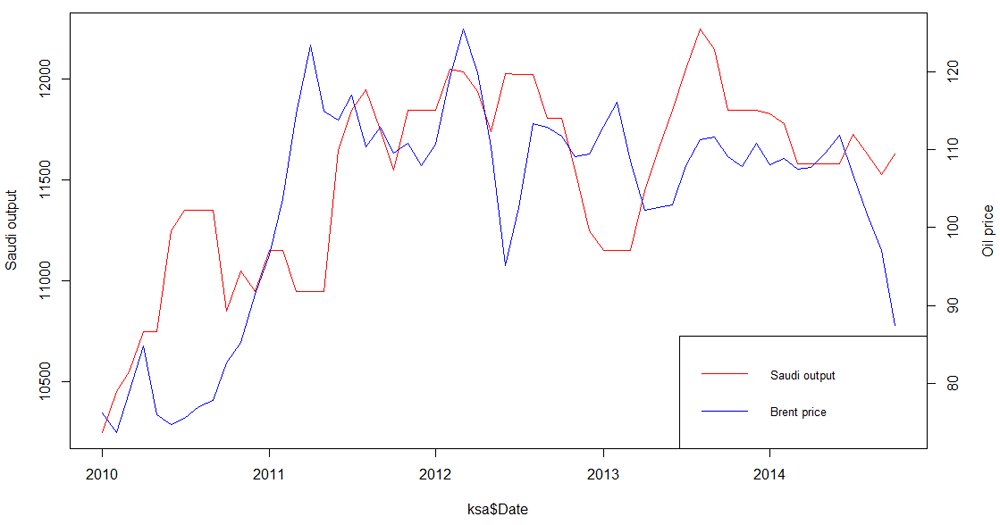 Historically, Saudi Arabia has played a stabilizing role in world oil prices, by adjusting its output to ensure global supply is stable. The above graph show how Saudi output increased to lower prices when they were high, and vice versa. However, since July, the Saudis have not responded to newly low oil prices by decreasing output. In fact, the Kingdom have insisted that they would rather bear lower oil prices than decrease their market share (read: be squeezed out by shale).
The IMF’s Big Greek Mistake
Ultimately, the authorities’ approach merely replaced one problem with another: IMF and official European loans were used to repay private creditors. Thus, despite a belated restructuring in 2012, Greece’s obligations remain unbearable — only now they are owed almost entirely to official creditors.
 Abnormal Capitalist