
What I Learned from Losing $200 Million


That was one hell of a trade. Boy, what a wild ride.

The Sunday after Lehman fell, pacing my empty trading floor, I realized once and for all that my models and reports could no longer tell me what to do. The one unmistakable fact was that my risks would increase if oil continued its decline. I decided that when I came in on Monday, I’d place a big bet that WTI would do just that.

And on a Saturday morning bike ride up the Hudson, it occurred to me that Mexico might be willing to restructure its deal—selling us back the option it owned, and buying a new one—in a way that would lock in billions of profits for the country, while giving me a much needed windfall too. I dropped my bike in a bush and texted our salesperson about the idea.

There were many other decisions and guesses, some made alone, others with help from my team, and still others made by my boss. All were guesswork, none could I have anticipated in stress testing, and all involved abandoning my original strategy along with the illusion of control it gave me.
→ Nautilus

Inside Job

A story on Raj Rajaratnam’s inside job and an unsuspected collateral damage:

In my many conversations with Das, I had failed to explain to her what insider trading was, how she ended up a millionaire on paper, and what her employer did in her name. Her sole source of aggrievement was the sum of Rs 8.5 lakh she believed Kumar owed her. Now, I heard her voice on the crackling line fill with hope. “Will he give me the two years’ pay he promised?” she asked. “If he does, that will be very good.” But, after a pause, she added, “If he does not, my life will continue.”

→ Caravan Magazine

What If Banks Didn’t Create Money?

Switzerland to revive the 100 percent reserve banking argument :

The fall of Communism completely discredited the idea of a planned economy; even in the Soviet Union for about two decades before its collapse, few believed state planning could work. Somehow, the idea that governments are less evil and better at making financial decisions than private banks has survived that disaster. It’s mainly the banks’ fault: They have been flagrantly irresponsible. A state monopoly on money could test the theory, and Switzerland, where the central bank is disinclined to do crazy things and democratic institutions are more powerful than in most other places, could be an ideal proving ground.

→ Bloomberg

Warren Buffett: Oracle or Orang-utan?

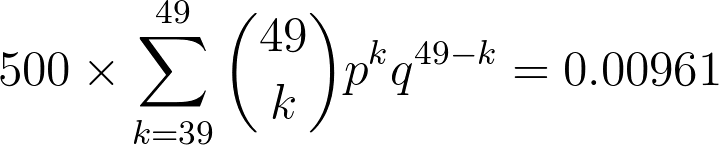
Buffett has taken the criticism from these fellow giants of finance in his stride, responding with trademark wit and humour. He even compared himself to an orang-utan flipping coins. Joking aside, this is a testable hypothesis: Is Buffett’s performance better than chance? To test it, we will stand on the shoulders of another giant: Jacob Bernoulli.

• • •

Again it is a very small number, but we can use our formula to calculate its value:

The expected value is much smaller than 1, so we can conclude that Buffett is a better investor than the luckiest orang-utan. If stock returns really do follow a random process – as Eugene Fama asserted – then Warren Buffett is more than just lucky. Compared with his competitors in the S&P 500, he’s brilliant.

→ StatsLife

Math’s Beautiful Monsters


From fluid dynamics to finance, creatures like the Weierstrass function have challenged our ideas about the relationship between mathematics and the natural world. Mathematicians around the time of Weierstrass used to believe that the most useful mathematics was inspired by nature, and that Weierstrass’ work did not fit into that definition. But stochastic calculus and Mandelbrot’s fractals have proven them wrong. It turns out that in the real world—the messy, complex real world—monsters are everywhere. “Nature has played a joke on the mathematicians,” as Mandelbrot put it. Even Weierstrass himself fell victim to the trick. He created his function to argue that mathematics should not be based only on physical observations. His followers believed that Newton had been constrained by real-life intuition and that, once free of these limitations, there were vast, elegant new theories to be discovered. They thought that mathematics would no longer need nature. Yet Weierstrass’ monster has revealed the opposite to be true. The relationship between nature and mathematics runs deeper than anyone ever imagined.

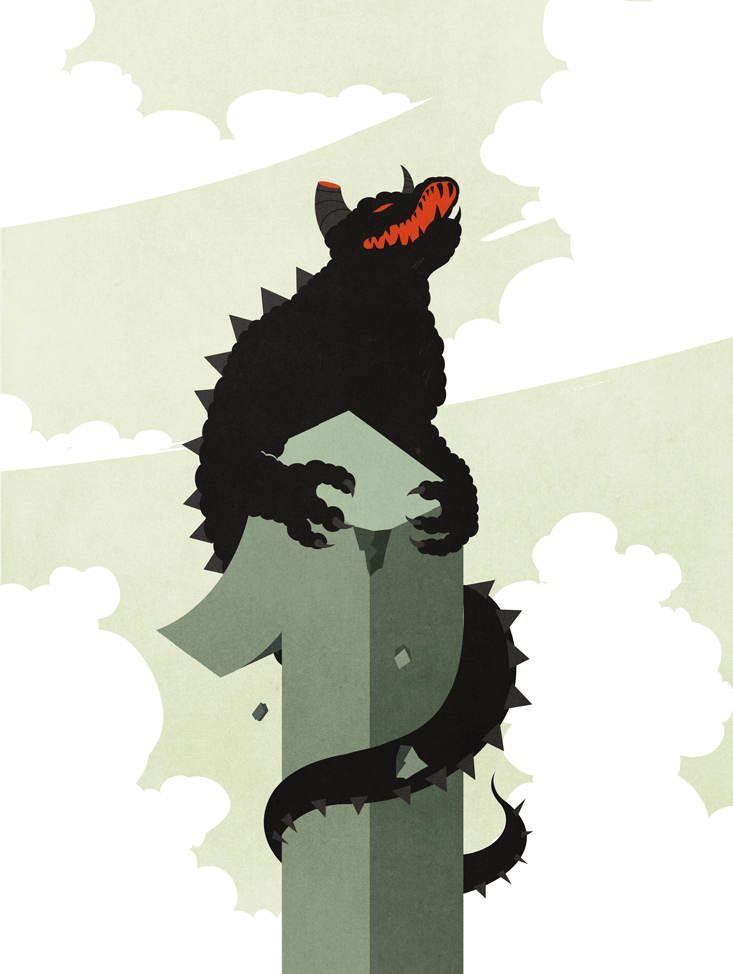
Illustration : Alessandro Gottardo

→ Nautilus