Reality = Normal + Fat-Tail Distributions

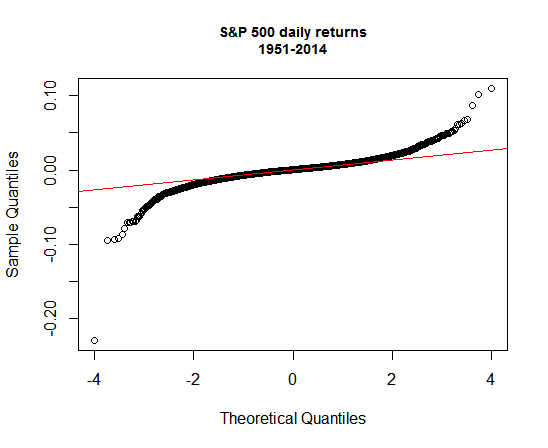
To illustrate the phenomenon, consider the S&P’s daily percentage returns in terms of quantiles, which divides the performance record into equal-sized portions. The graph below plots the sample return of the S&P (black circles) against the theoretical quantiles (red line), defined here by a random distribution. If the S&P’s daily returns were perfectly random, the black circles would match the red line.
sp.a.25sep2014

Normal distributions are still useful for analyzing markets and designing portfolios. Indeed, even in the daily return plot above it’s clear that the distribution looks quite normal for a fair amount of the sample. We can’t rely on normality alone for modeling markets. Factoring in fat-tails risk is essential. But letting a fat-tail worldview dominate your analysis is every bit as flawed as assuming that normal distributions will prevail. Asset pricing doesn’t neatly fit into one theoretical box, which means that our analytical tool kit shouldn’t be in a conceptual straightjacket either.

→ The Capital Spectator

The Economics of Ebola

When pharmaceutical companies are deciding where to direct their R. & D. money, they naturally assess the potential market for a drug candidate. That means that they have an incentive to target diseases that affect wealthier people (above all, people in the developed world), who can afford to pay a lot. They have an incentive to make drugs that many people will take. And they have an incentive to make drugs that people will take regularly for a long time—drugs like statins.

***

Diseases that mostly affect poor people in poor countries aren’t a research priority, because it’s unlikely that those markets will ever provide a decent return. So diseases like malaria and tuberculosis, which together kill two million people a year, have received less attention from pharmaceutical companies than high cholesterol.

→ The New Yorker

To Predict Turbulence, Just Count the Puffs

It’s not that the stakes are low. A thorough explication of turbulence in pipes could help illuminate the transition to turbulence in a wide range of settings. Understanding how to minimize turbulence in air and fluids could ultimately help engineers pump oil through long pipelines more efficiently and build cars that generate less wind resistance. It could also allow them to harness turbulence more effectively in the settings in which it is helpful, as when vortices near an airplane wing pull a smooth layer of air toward the wing and allow the plane to come in for a slower and gentler landing.

→ Nautilus

Why Is Finance So Complex ?

Financial systems are sugar pills by which we collectively embolden ourselves to bear economic risk. As with any good placebo, we must never understand that it is just a bit of sugar. We must believe the concoction we are taking to be the product of brilliant science, the details of which we could never understand. The financial placebo peddlers make it so.

→ Interfluidity