The Astrophysicists Who Faked It

Credit : LIGO/Axel Mellinger

In science, the question of when to believe is a deep and ancient problem. There is no universal answer, and evaluating the merits of any potential discovery always includes considering the prior beliefs of the people involved. There is no way around this.

• • •

This was the genius of the fake signal injection: Whatever the prior belief of an individual scientist might be, it gave him or her reason to doubt it. A scientist who believed that the current generation of instruments was simply not up to the task would have to allow for the possibility that it was. A scientist tempted to elevate a signal because of the benefits of a real detection would have to temper his or her enthusiasm to avoid making a false claim. The fake injection bugaboo forced us to keep an open mind, apply skepticism and reason, and examine the evidence at face value.
→ Nautilus

The Little Professor Syndrome

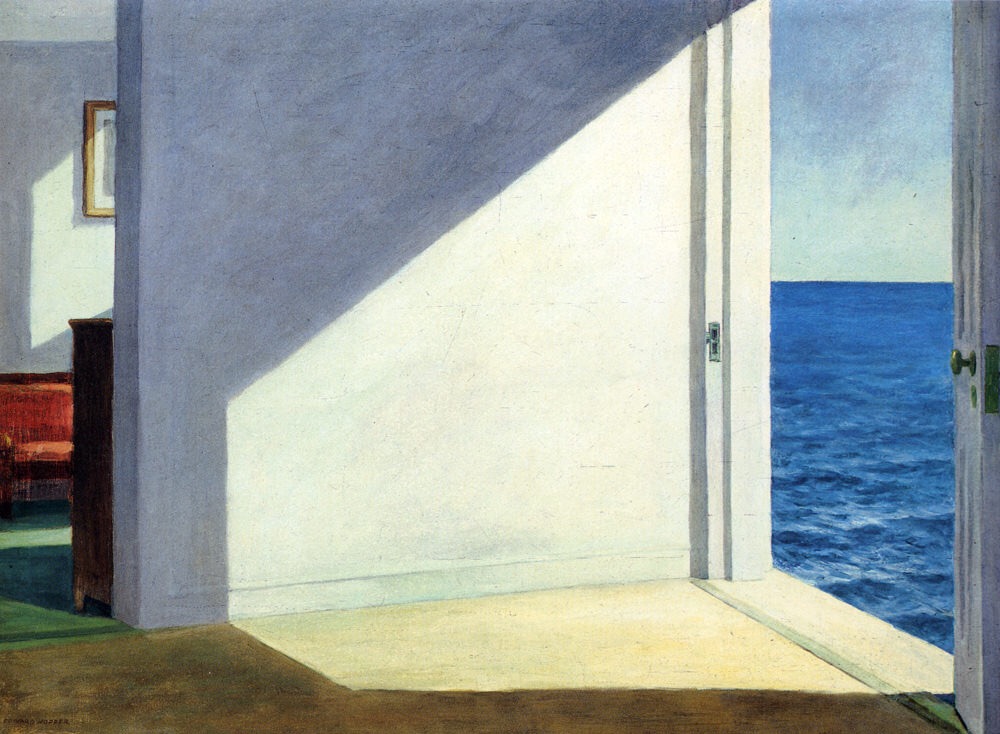
Edward Hopper

On the Asperger syndrome :

At first glance, this brightly decorated room is no different from that of any other elementary school. Shelves are filled with storybooks; on the chalkboard, a vertical line of words reads ”prudence,” ”pretzel,” ”prairie,” ”purple.” But the nervous agitation of the boys’ hands, punctuated by occasional odd flapping gestures, betrays the fact that something is off kilter. There is also a curious poster on one of the walls with a circle of human faces annotated with words like ”sad,” ”proud” and ”lonely.” When I ask Cacciabaudo about it, she explains that her students do not know how to read the basic expressions of the human face. Instead, they must learn them by rote.

→ The New York Times

Should Science Save Modern Art?

At an international art symposium called “Fail Better,” held in 2013 at the Hamburg Museum in Germany, Nagy and Barger discussed the idea of teaching the public a new way of looking at art. “We don’t object to seeing time’s toll on classical art,” Learner said in a phone interview. “We’ve come to expect the pretty green patina on Donatello’s ‘David.’ We like it.” And perhaps it’s time to see the same thing in modern art, Barger says. “Will brittle latex and yellowing plastic ever seem classic and dignified?” she asks. “Maybe we need to accept this.”

In the end, Barger decided to show “Aught” in the 2002 exhibition after restoring it in the least invasive way she could. She applied laminated cheesecloth using methylcellulose—a synthetic liquid adhesive—to strengthen the brittle parts, keep the latex from dripping, and to give the exterior more loft. The piece became a star of the three-month exhibit. Degraded and imperfect as it was, it succeeded in challenging the public to consider the temporality of art, and of their own lives. Johns recalls how Hesse once looked at the discolored latex jungle of cables that “Untitled (Rope Piece)” had become, and described it as “my chaos.” “She gloated at the transience of it,” Johns says. Not long afterward, Hesse gave an interview to Artforum. Asked if she worried about the impermanence of her materials, she responded, “Life doesn’t last, art doesn’t last.” She died three months later, at age 34.

→ Nautilus

How I Used Maths To Beat The Bookies

There is a caveat to all of my modelling work, a small detail that I haven’t yet revealed. It is this. What I haven’t mentioned is that I had a fifth model. It was called “ask my wife”. Lovisa Sumpter is a very talented individual. She is an associate professor of mathematics education in Sweden, where we live, and a qualified yoga instructor. She also has a much better record than her husband in football betting. When she was still a student, Lovisa correctly predicted the outcome of every one of the 13 matches in the Swedish Stryktipset. The chance of getting these right by picking randomly is 1 in 3 to the power of 13 (or 1/1,594,323). Although the pay-out for her winning week was relatively small, she remains proud of being one of the few people in Sweden to “get 13 right”.

→ 1843 Magazine

Learning to Love Complex Numbers

Numbers are curious things. On one hand, they represent one of the most natural things known to humans, which is quantity. It’s so natural to humans that even newborn babies are in tune with the difference between quantities of objects between 1 and 3, in that they notice when quantity changes much more vividly than other features like color or shape.

But our familiarity with quantity doesn’t change the fact that numbers themselves (as an idea) are a human invention. And they’re not like most human inventions, the kinds where you have to tinker with gears or circuits to get a machine that makes your cappuccino. No, these are mathematical inventions. These inventions exist only in our minds.

→ Math ∩ Programming