
Why The World’s Most Famous Acoustic Architect Says His Design Strategy Is To ‘Just Pray’

There are all kinds of theories about what makes a room sound good. One of the leading researchers in the field compares concert hall acoustics to tasting wine: some characteristics are easyily classifiable, but perception and taste are part of the equation, too. Another has suggested that understanding the way sound reflects in a room, not the shape of it, is the critical component to good concert hall design.

But the craziest theory comes from a researcher named Zackery Belanger. He thinks that acoustics is primarily a geometric problem, a theory so radical that he was forced out of his Ph.D. program because his advisor disagreed with it.

→ Fusion

Warren Buffett: Oracle or Orang-utan?

Buffett has taken the criticism from these fellow giants of finance in his stride, responding with trademark wit and humour. He even compared himself to an orang-utan flipping coins. Joking aside, this is a testable hypothesis: Is Buffett’s performance better than chance? To test it, we will stand on the shoulders of another giant: Jacob Bernoulli.

• • •

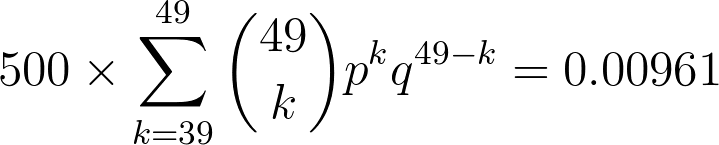
Again it is a very small number, but we can use our formula to calculate its value:

The expected value is much smaller than 1, so we can conclude that Buffett is a better investor than the luckiest orang-utan. If stock returns really do follow a random process – as Eugene Fama asserted – then Warren Buffett is more than just lucky. Compared with his competitors in the S&P 500, he’s brilliant.

→ StatsLife

Math’s Beautiful Monsters


From fluid dynamics to finance, creatures like the Weierstrass function have challenged our ideas about the relationship between mathematics and the natural world. Mathematicians around the time of Weierstrass used to believe that the most useful mathematics was inspired by nature, and that Weierstrass’ work did not fit into that definition. But stochastic calculus and Mandelbrot’s fractals have proven them wrong. It turns out that in the real world—the messy, complex real world—monsters are everywhere. “Nature has played a joke on the mathematicians,” as Mandelbrot put it. Even Weierstrass himself fell victim to the trick. He created his function to argue that mathematics should not be based only on physical observations. His followers believed that Newton had been constrained by real-life intuition and that, once free of these limitations, there were vast, elegant new theories to be discovered. They thought that mathematics would no longer need nature. Yet Weierstrass’ monster has revealed the opposite to be true. The relationship between nature and mathematics runs deeper than anyone ever imagined.

Illustration : Alessandro Gottardo

→ Nautilus

The Fable Of The Unicorn

Yet in other ways Theranos evokes a central theme in today’s tech industry: start-ups which promise to disrupt lucrative businesses and become valued on the basis of fantasies about their potential, rather than present reality. Investors are so keen to get a piece of any sexy-sounding startup that they lap up entrepreneurs’ hype—and anyone who asks awkward questions risks being cut out of the funding round in favour of someone more trusting.

All this helps to explain the inflation of valuations among unlisted technology companies. Today there are 142 unicorns, more than three times as many as in 2013. Many of them are growing quickly. But in terms of reaching profitability, they are often far behind the stockmarket-listed competitors they are seeking to displace, and thus are burning through cash. Theranos, for example, is not believed to have any significant revenues or profits, yet it is valued about as highly as Quest Diagnostics, a listed laboratory company, which achieved $7.4 billion in revenues and nearly $600m in net profits in 2014.

→ The Economist

How To Build A Search Engine For Mathematics

Ultimately, it all comes back to counting things, and counting is a universally handy tool. Which in turn makes the encyclopedia handy, too. “Suppose you are working on a problem in one domain, say, electronics, and while solving a problem you encounter a sequence of integers,” said Manish Gupta, a coding theorist by training who runs a lab at the Dhirubhai Ambani Institute of Information and Communication Technology. “Now you can use the encyclopedia and search if this is well known. Many times it happens that this sequence may have appeared in a totally unrelated area with another problem. Since numbers are the computational output of nature, to me, these connections are quite natural.”

→ Nautilus