Does the left have a future?

2560

No party can exist forever. Political traditions can decline, and then take on new forms; some simply become extinct. All that can be said with certainty is that if the left is to finally leave the 20th century, the process will have to start with the ideas and convictions that answer the challenges of a modernity it is only just starting to wake up to, let alone understand.

→ The Guardian

The Little Professor Syndrome

Edward Hopper

On the Asperger syndrome :

At first glance, this brightly decorated room is no different from that of any other elementary school. Shelves are filled with storybooks; on the chalkboard, a vertical line of words reads ”prudence,” ”pretzel,” ”prairie,” ”purple.” But the nervous agitation of the boys’ hands, punctuated by occasional odd flapping gestures, betrays the fact that something is off kilter. There is also a curious poster on one of the walls with a circle of human faces annotated with words like ”sad,” ”proud” and ”lonely.” When I ask Cacciabaudo about it, she explains that her students do not know how to read the basic expressions of the human face. Instead, they must learn them by rote.

→ The New York Times

The Writer and the Rebellion

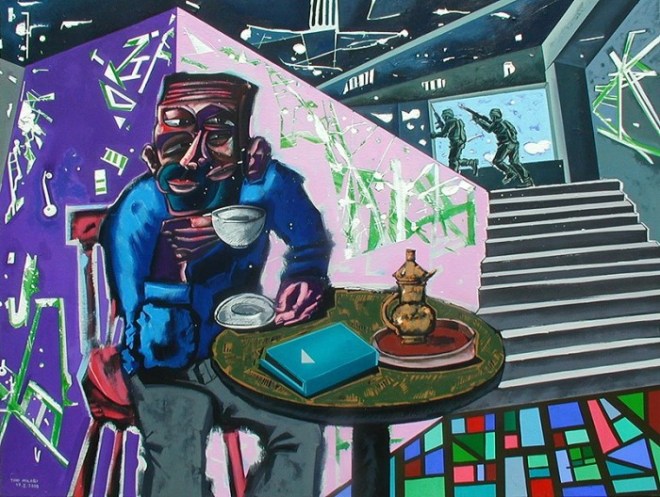
tonimilaqi5-086-11
Toni Milaqi, Coffe Time
July 2011 :

That evening, we went to George’s, Iowa City’s Qasabji: a dim, narrow bar of perpetual darkness. We met friends who still lived in town and drank and talked late into the night. “I think now, in Syria, we have a very new idea,” Khaled told me. “Now I’m writing my new novel. I have been writing for four years. But now, I will rewrite it, because I feel it is old writing. We have a new time, and new ideas, not just for writing but for the people too. Now we can understand our people. We are talking about this with young writers. What will be the future, I ask. You must be better. Because after the revolution you have new ideas about writing and about all art. We will have new ideas.”

→ Guernica Magazine

Why People Pay To Read The New York Times

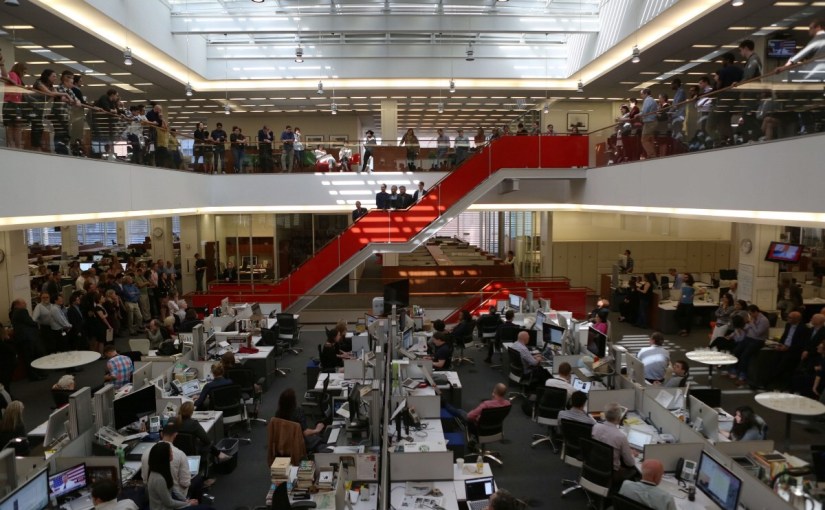
In the United States, the ranks of journalists keep shrinking. As I travel around the world for The New York Times, I hear from journalists everywhere about the painful downsizing happening across the industry. This has meant important stories go untold. Costly investigative reporting units pare back their ambition in the face of budget cuts. Expensive trips to conflict zones suddenly seem like a luxury publishers cannot afford, and news organizations everywhere rely more and more on wire services to cover the world. This has reduced the vibrancy and diversity of the journalism we consume, and the world is poorer for it. Above all, local journalism has suffered. Cities that once supported two or more daily newspapers find themselves with one, or none at all.

→ Medium

Disgraced Trader’s Struggle for Redemption

“It’s not necessarily about money, it’s about winning,” he told a visiting group of American college students. He told them that to understand trading, they needed to forget everything they learned in economics class and envision the amoral, take-no-prisoners world of “The Hunger Games.”

“The only time when people cooperate is to prolong their own lives,” he said. When rivals are no longer useful, “you stab them in the back.”

He told students he had accepted the fact that he was a rogue trader—but in his telling, it didn’t sound all that sinister.

A rogue trader, he said, “is a risk taker. It’s not a crime. It’s violating the mores established by the institution that you work for. It’s a rebellion against institutional controls that deny individuals opportunities for self-actualization.”

→ The Wall Street Journal