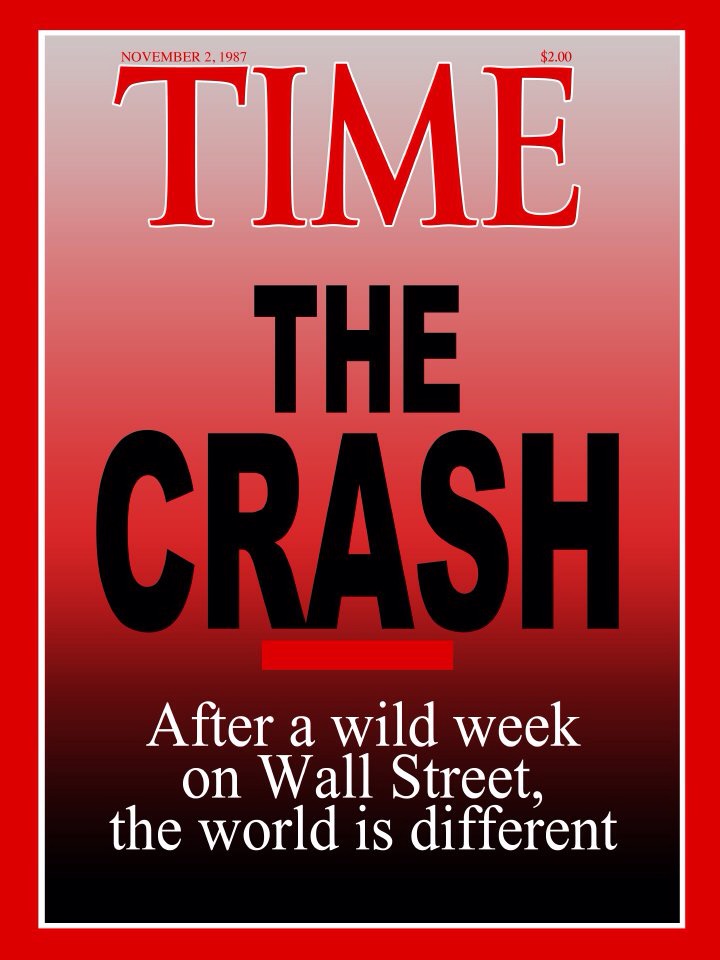
A short and informative recollection of what happened roughly three decades ago, from Barry Ritholtz :
Where were you on Monday, Oct. 19, 1987?
Today is the first time since 2009 that Oct. 19 has fallen on a Monday, and that has me thinking about that day. I recall exactly where I was — in graduate school, walking between classes, when I passed a television broadcasting the collapse.
New York Magazine had a great piece too on February 2008 :
It all started, of course, on Wall Street. On Black Monday, October 19, 1987, the Dow Jones index, for reasons still being debated, fell 508 points, almost a quarter of its total. (The current equivalent, for comparison’s sake, would be a 3,200-point loss on one day.) The drop turned out to be a “black swan event,” a weirdly poetic economist’s term meaning, basically, a fluke (though few people remember it, the Dow still eked out a positive finish for the year). Still, the hiccup seemed to foretell the instability to come. Over the next two years, with the economy perceived to be overheating, the Fed repeatedly jacked up interest rates, which made bonds and T-bills sexier than stocks, which triggered an epidemic of unscrupulous bond peddling, which further destabilized the market—leading to a slowdown. (If that all sounds disturbingly like the recent subprime-debt mess, well, that’s because it is. But more on that later.) And a slowdown on Wall Street, which provides over 20 percent of the city’s cash income, spells a slowdown for New York.
→ Bloomberg View

 Abnormal Capitalist