Should Science Save Modern Art?

At an international art symposium called “Fail Better,” held in 2013 at the Hamburg Museum in Germany, Nagy and Barger discussed the idea of teaching the public a new way of looking at art. “We don’t object to seeing time’s toll on classical art,” Learner said in a phone interview. “We’ve come to expect the pretty green patina on Donatello’s ‘David.’ We like it.” And perhaps it’s time to see the same thing in modern art, Barger says. “Will brittle latex and yellowing plastic ever seem classic and dignified?” she asks. “Maybe we need to accept this.”

In the end, Barger decided to show “Aught” in the 2002 exhibition after restoring it in the least invasive way she could. She applied laminated cheesecloth using methylcellulose—a synthetic liquid adhesive—to strengthen the brittle parts, keep the latex from dripping, and to give the exterior more loft. The piece became a star of the three-month exhibit. Degraded and imperfect as it was, it succeeded in challenging the public to consider the temporality of art, and of their own lives. Johns recalls how Hesse once looked at the discolored latex jungle of cables that “Untitled (Rope Piece)” had become, and described it as “my chaos.” “She gloated at the transience of it,” Johns says. Not long afterward, Hesse gave an interview to Artforum. Asked if she worried about the impermanence of her materials, she responded, “Life doesn’t last, art doesn’t last.” She died three months later, at age 34.

→ Nautilus
Deutsche Bank’s $10-Billion Scandal

160829_r28563-1199x1200-1471540574
Illustration by Anna Parini
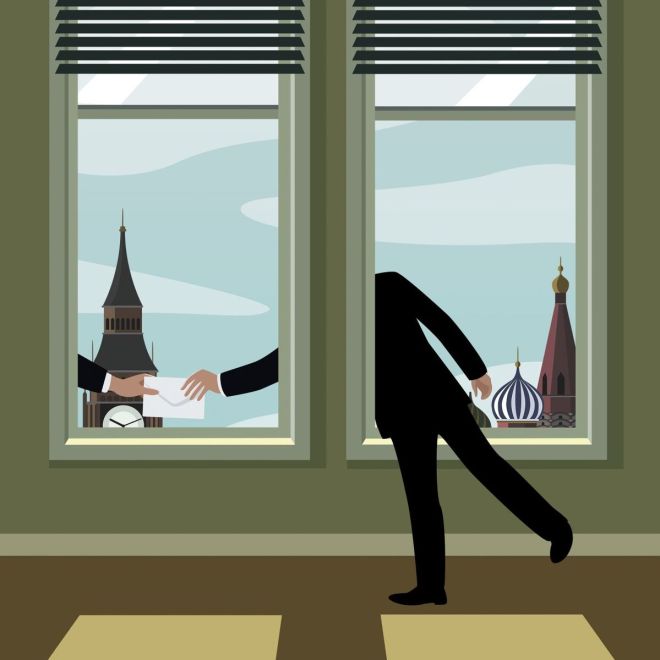
On an April evening in Moscow, I met with a broker who had intimate knowledge of the structure of the mirror trades. The city was emerging from the choking cold of winter, and young people flirted outside Paveletskaya Station as if it were high summer. As the broker and I walked across the square, he characterized mirror trades as just one of a thousand ruses employed by smart businessmen. But why, I asked him, would somebody with a prominent position at a major bank get involved in such a scheme? Wiswell’s annual compensation was in the region of a million and a half dollars. The broker laughed. He said that Wiswell had been paid handsomely by clients of the mirror trades. For the architects of the scheme, the broker explained, it was worth it to bribe someone inside the bank: “Guys always pay something. They think it will hook you, so you are not going to do unexpected things.” In the estimation of the broker, Wiswell was a useful functionary but hardly a criminal genius. Sometimes, the broker said, money was transferred into an offshore account maintained by Wiswell’s wife, and sometimes cash was delivered to Wiswell in a bag.

→ The New Yorker

The Daredevil of the Auction World

Capturechris

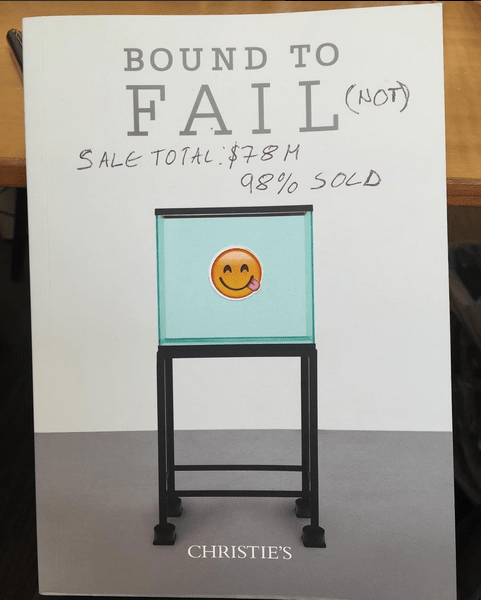
With contemporary art having become an important investment vehicle for the superwealthy—a profitable and fun place for the rich to park their money—collectors are no longer necessarily connoisseurs. Gouzer is disdainful of the novice client who shows no interest in an artist’s catalogue raisonné, and who wants to know only if the piece he is buying is considered to be in the top ten of the artist’s works. “It’s very much an Instagram way of buying,” he grumbled to me this spring. “You see an image, and you make a decision.” Yet his approach could not be better calculated to appeal to such consumers. Last November, a colleague at Christie’s brought to auction a Modigliani painting of a voluptuous woman, “Reclining Nude,” which had a presale estimate of a hundred million dollars. Gouzer posted an image of the painting on Instagram and offered this unscholarly observation: “Difficult to say which you would want more, the painting for a lifetime or the model for a night?”

→ The New Yorker

The Writer and the Rebellion

tonimilaqi5-086-11
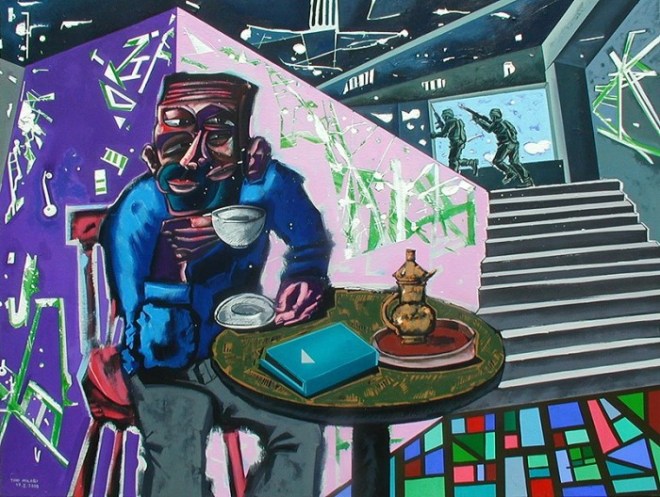
Toni Milaqi, Coffe Time
July 2011 :

That evening, we went to George’s, Iowa City’s Qasabji: a dim, narrow bar of perpetual darkness. We met friends who still lived in town and drank and talked late into the night. “I think now, in Syria, we have a very new idea,” Khaled told me. “Now I’m writing my new novel. I have been writing for four years. But now, I will rewrite it, because I feel it is old writing. We have a new time, and new ideas, not just for writing but for the people too. Now we can understand our people. We are talking about this with young writers. What will be the future, I ask. You must be better. Because after the revolution you have new ideas about writing and about all art. We will have new ideas.”

→ Guernica Magazine