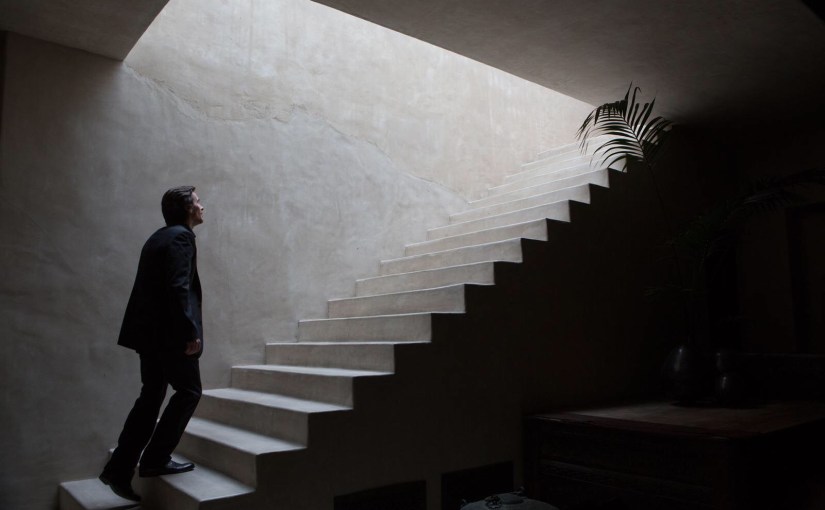
Terrence Malick’s “Knight of Cups” Challenges Hollywood to Do Better

It reminds me of Claude Lelouch :

For Malick, the cinema is also a matter of the unconscious, of indeterminacy, of tension between decision and accident. Most of the movie’s images are done with a handheld camera, and most of them involve so much motion, on the part of the actors and the camera alike, that they would defy, in the rapidity of their complexity, any attempt to calibrate them in advance to the exact framing and composition. Malick creates the circumstances under which Lubezki can make these images; Lubezki, untethered to storyboards, roaming freely around and past the action, collects images that embody Malick’s ideas and emotions without being overdetermined by his intentions.

The Knight of Cups is a good movie, but unfortunately not a great one.

→ The New Yorker

Mathematician Solves the Centuries-Old Sphere Problem in Higher Dimensions

It’s possible to build an analogue of the pyramidal orange stacking in every dimension, but as the dimensions get higher, the gaps between the high-dimensional oranges grow. By dimension eight, these gaps are large enough to hold new oranges, and in this dimension only, the added oranges lock tightly into place. The resulting eight-dimensional sphere packing, known as E8, has a much more uniform structure than its two-stage construction might suggest. “Part of the mystery here is this object turns out to be vastly more beautiful and symmetric than it sounds,” Cohn said. “There are tons of extra symmetries.”

→ Wired

My Brief Carrer As An Indian Ocean Tax Pirate


In the end I let my offshore structure collapse soon after setting it up. Unlike some of my offshore counterparts I could not afford the annual £700 charge to maintain them.

My offshore empire was built at my kitchen table with just a few thousand pounds and Emily for help. I can only imagine what kinds of opaque and impenetrable structures could be created by those with the financial means large enough to be employing companies such as Mossack Fonseca.

→ Financial Times

The Art of Larry Gagosian’s Empire

Larry, Jean-Michel Basquiat (1985)

One of Gagosian’s particular talents is conjuring complex, chesslike transactions that offer elements more enticing than cash. “He’s like a block trader,” says collector and Blackstone chairman, CEO and co-founder Stephen Schwarzman, referring to the financial practice of making high-risk, fast-moving private deals on large quantities of shares. “He’s in the matching business.” When Schwarzman, for example, was seeking a rare Twombly “blackboard” painting for his apartment, “Larry found someone in Korea who owned a painting and found another painting that was larger and more important,” Schwarzman says. “So they sold their painting and bought another from Larry. That’s a classic Larry Gagosian execution—where everyone’s happy and Larry makes tons of money.”

→ WSJ Magazine

Why Physics Is Not a Discipline


Physics, properly understood, is not a subject taught at schools and university departments; it is a certain way of understanding how processes happen in the world. When Aristotle wrote his Physics in the fourth century B.C., he wasn’t describing an academic discipline, but a mode of philosophy: a way of thinking about nature. You might imagine that’s just an archaic usage, but it’s not. When physicists speak today (as they often do) about the “physics” of the problem, they mean something close to what Aristotle meant: neither a bare mathematical formalism nor a mere narrative, but a way of deriving process from fundamental principles.

→ Nautilus