The next day, a Friday, Tang was taken off life support. Over the weekend, on top of the grief of losing a close friend, Ferguson began to grapple with an all-but-impossible choice that he and Marshall would soon face: “How could we go on with Kitchit absent George?” he told Forbes. “And on the other hand, how could we not?”
Author: Edouard Chazal
The $80 Million Fake Bomb-Detector Scam
How could nearly 4,000 pounds of explosives have passed, undetected, into one of the city’s most tightly controlled areas ?
The first impulse was to look for infiltrators and collaborators. Some 60 suspects who had worked at checkpoints and local police posts near the bombings were rounded up. But the real problem, it turned out, was with the handheld bomb detectors being used at just about every Iraqi-run checkpoint in the country. They were toys. They had never worked. It had all been an expensive charade—costing the Iraqi government tens of millions of dollars and hundreds of lives—engineered by a portly middle-aged salesman in Britain.
Weekend of Fear in Greece as Monday Brings Salvation or Ruin
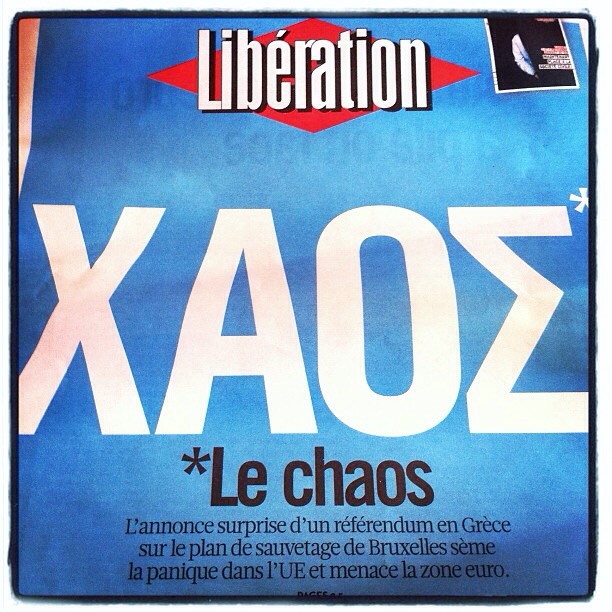
Dorothea Lambros stood outside an HSBC branch in central Athens on Friday afternoon, an envelope stuffed with cash in one hand and a 38,000 euro ($43,000) cashier’s check in the other.
She was a few minutes too late to make her deposit at the London-based bank. She was too scared to take her life-savings back to her Greek bank. She worried it wouldn’t survive the weekend.
“I don’t know what happens on Monday,” said Lambros, a 58-year-old government employee.
Nobody does. Every shifting deadline, every last-gasp effort has built up to this: a nation that went to sleep on Friday not knowing what Monday will bring. A deal, or more brinkmanship. Shuttered banks and empty cash machines, or a few more days of euros in their pockets and drachmas in their past — and maybe their future.
More Ties Than We Thought
There is 177,147 different tie knots according to this paper.
The pair used an existing tool from logic – known as formal language theory – to express the basic rules of tying a neck tie as a series of symbols. This included things like the placement of the tie, the direction of the fold and the need to end in a final tuck. They used their tie language to show that only 85 knots were possible.
Now mathematician Mikael Vejdemo-Johansson of the KTH Royal Institute of Technology in Stockholm, Sweden, has vastly broadened the tie landscape.

Bill Gross Thinks The End Is Near
Sorkin: I have to know: Why do you wear your tie like that?
Gross: I came down here to Orange County in ’71 from L.A., and Pimco had this brand-new, beautiful building, but they didn’t have a gym or showers. I was an exercise nut. At noon, I’d change in the bathroom and then run for about five miles. Since there wasn’t a shower, I’d towel off as best I could, but I’d be sweating and hot for an hour or two. So in the afternoon, I began to just not tie my tie. Then a year or two later, I said: “Well, what the hell, I guess I’m not tying it in the afternoon, I’ll just not tie it in the morning either.”
 Abnormal Capitalist