40 Years Since Saigon’s Fall

Rembering a brother and one of the most iconic photograph of the century :

“My brother, very good photographer,” Ut says, stepping away from where he shot his most famous photo. “I really love him. Every time he came back from assignments and showed the pictures, people die, the war. He showed his wife, he showed me. He was very angry. He said one day he was going to take a picture that would stop the war. But he never did. When he died, I heard his words in my ear. When I took the picture of Kim Phuc, I told my brother: ‘I have it for you.’”

Note : Title purposely shortened. 
→ The Guardian

My Quantified Email Self Experiment: A failure

Paul Ford on looking back, digitally :

My big idea was: If I can quickly look through all of my old emails I will be able to observe how my thoughts have evolved. I’ll learn something fundamental about myself and how I’ve grown as a person —for example, the difference between being in my early 20s and being 40.

This seemed like an interesting thing to do, so I did it. But the experiment was a failure, and not very edifying.

→ Medium

Greek Parallel Currency: How to Do it Properly

The TCC avenue would clearly be a superior solution, and would allow Greece to stayin the Eurozone, while stimulating demand by increasing citizens’ purchasing power, reducing domestic labor costs, and significantly increasing GDP. This would also generate, in due course, higher gross tax receipts (which would offset the shortfall in euro fiscal revenue due to TCC issuance).

→ EconoMonitor

Who Is Saudi Arabia Really Targeting In Its Price War?

Follow-up on the previous article, this one from Arthur Berman for Naked Capitalism :

Prolonged low oil prices will prove that tight oil plays need at least $75 per barrel to break even. When oil prices recover to that level, only the best parts of the tight oil core areas will be competitive in the global market. As production declines from expensive tight oil, oil sand and ultra-deep-water plays, inexpensive Saudi oil will gain market share.

Saudi Arabia is not trying to crush tight oil plays, just the stupid money that funded the over-production of tight oil. Too much supply combined with weak demand created the present oil-price collapse. Saudi Arabia hopes to prolong low prices to benefit their long-term needs for market share and higher demand.

→ Naked Capitalism

Why Oil Prices Came Down, And Won’t Anymore

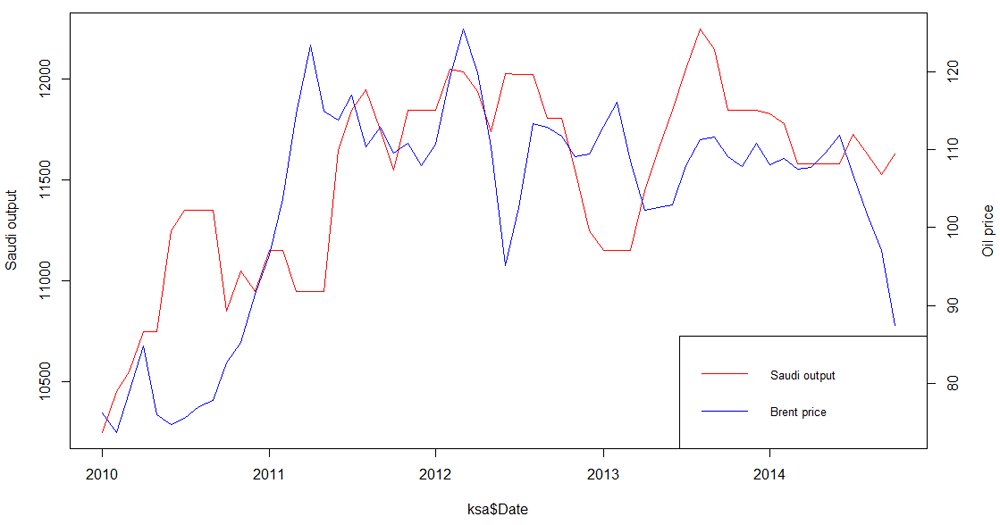
Historically, Saudi Arabia has played a stabilizing role in world oil prices, by adjusting its output to ensure global supply is stable. The above graph show how Saudi output increased to lower prices when they were high, and vice versa. However, since July, the Saudis have not responded to newly low oil prices by decreasing output. In fact, the Kingdom have insisted that they would rather bear lower oil prices than decrease their market share (read: be squeezed out by shale).

→ Stats Life