The $40-Million Elbow

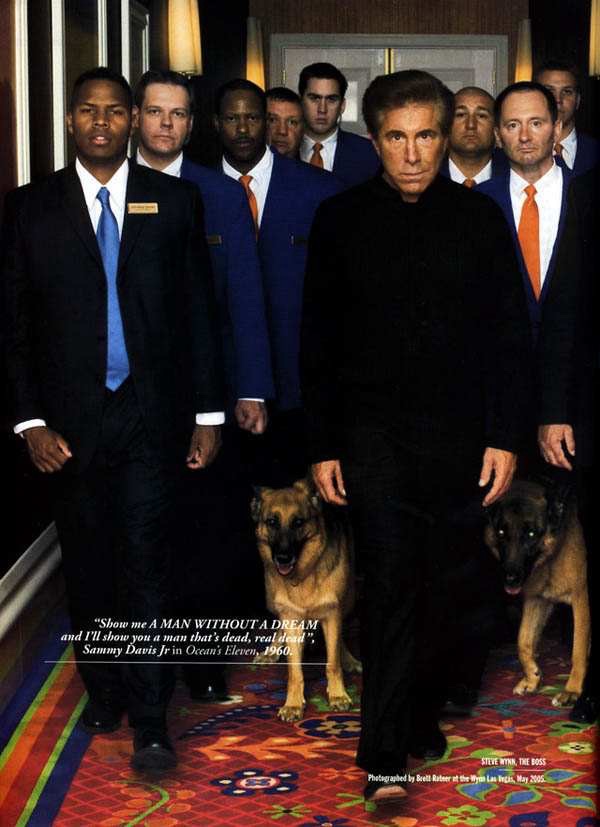
Brett Ratner for Vogue Hommes International, 2005

Wynn turned around again. He put his pinkie in the hole and observed that a flap of canvas had been pushed back. He told his guests, “Well, I’m glad I did it and not you.” He said that he’d have to call Cohen and William Acquavella, his dealer in New York, to tell them that the deal was off. Then he resumed talking about his paintings, almost, but not quite, as though he hadn’t just delivered what one of the guests would later call, in an impromptu stab at actuarial math, a “forty-million-dollar elbow.”

A few hours later, they all met for dinner, and Wynn was in a cheerful mood. “My feeling was, It’s a picture, it’s my picture, we’ll fix it. Nobody got sick or died. It’s a picture. It took Picasso five hours to paint it.” Mary Boies ordered a six-litre bottle of Bordeaux, and when it was empty she had everyone sign the label, to commemorate the calamitous afternoon. Wynn signed it “Mary, it’s all about scale—Steve.” Everyone had agreed to take what one participant called a “vow of silence.”

And a similar story on fixing a Monet on Hyperallergic.

→ The New Yorker

Should Science Save Modern Art?

At an international art symposium called “Fail Better,” held in 2013 at the Hamburg Museum in Germany, Nagy and Barger discussed the idea of teaching the public a new way of looking at art. “We don’t object to seeing time’s toll on classical art,” Learner said in a phone interview. “We’ve come to expect the pretty green patina on Donatello’s ‘David.’ We like it.” And perhaps it’s time to see the same thing in modern art, Barger says. “Will brittle latex and yellowing plastic ever seem classic and dignified?” she asks. “Maybe we need to accept this.”

In the end, Barger decided to show “Aught” in the 2002 exhibition after restoring it in the least invasive way she could. She applied laminated cheesecloth using methylcellulose—a synthetic liquid adhesive—to strengthen the brittle parts, keep the latex from dripping, and to give the exterior more loft. The piece became a star of the three-month exhibit. Degraded and imperfect as it was, it succeeded in challenging the public to consider the temporality of art, and of their own lives. Johns recalls how Hesse once looked at the discolored latex jungle of cables that “Untitled (Rope Piece)” had become, and described it as “my chaos.” “She gloated at the transience of it,” Johns says. Not long afterward, Hesse gave an interview to Artforum. Asked if she worried about the impermanence of her materials, she responded, “Life doesn’t last, art doesn’t last.” She died three months later, at age 34.

→ Nautilus

The Daredevil of the Auction World

Capturechris

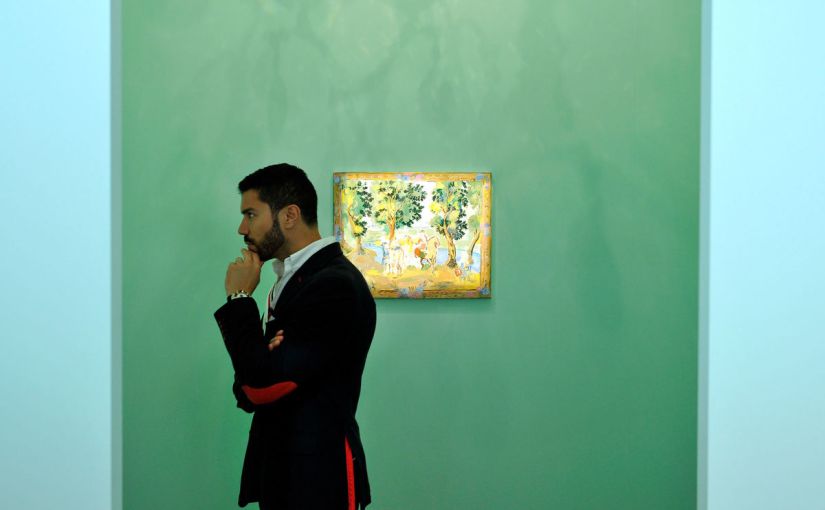
With contemporary art having become an important investment vehicle for the superwealthy—a profitable and fun place for the rich to park their money—collectors are no longer necessarily connoisseurs. Gouzer is disdainful of the novice client who shows no interest in an artist’s catalogue raisonné, and who wants to know only if the piece he is buying is considered to be in the top ten of the artist’s works. “It’s very much an Instagram way of buying,” he grumbled to me this spring. “You see an image, and you make a decision.” Yet his approach could not be better calculated to appeal to such consumers. Last November, a colleague at Christie’s brought to auction a Modigliani painting of a voluptuous woman, “Reclining Nude,” which had a presale estimate of a hundred million dollars. Gouzer posted an image of the painting on Instagram and offered this unscholarly observation: “Difficult to say which you would want more, the painting for a lifetime or the model for a night?”

→ The New Yorker

What Tech’s Unicorn Cult Can Learn from the Art World

The art world knows about prices floating ever higher on abstraction and hope. The resonances aren’t completely coincidental. Both venture capitalists and art buyers are in the business of valuing the invaluable. Both stake their reputations on exquisite selection. Both nurture talent before it can support itself. Both have a soft spot for youth, for unbowed ego, for the myth of solitary genius, for the next new thing. Both operate in a world of frustratingly limited information and maddeningly unpredictable success. Both depend on consumer culture while holding themselves superior to it. And both the art market and venture investing have become increasingly winner-take-all games, with more clout to the companies and artists backed by the most powerful dealers or venture capitalists.

Credit : Harold Cunningham

→ The New Yorker


The Art of Larry Gagosian’s Empire

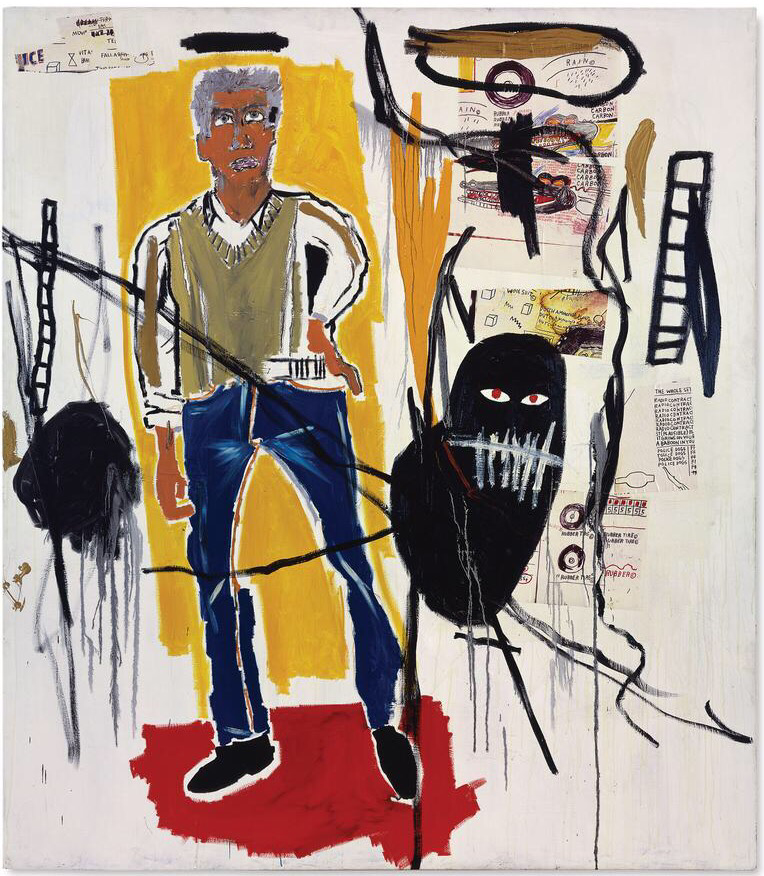
Larry, Jean-Michel Basquiat (1985)

One of Gagosian’s particular talents is conjuring complex, chesslike transactions that offer elements more enticing than cash. “He’s like a block trader,” says collector and Blackstone chairman, CEO and co-founder Stephen Schwarzman, referring to the financial practice of making high-risk, fast-moving private deals on large quantities of shares. “He’s in the matching business.” When Schwarzman, for example, was seeking a rare Twombly “blackboard” painting for his apartment, “Larry found someone in Korea who owned a painting and found another painting that was larger and more important,” Schwarzman says. “So they sold their painting and bought another from Larry. That’s a classic Larry Gagosian execution—where everyone’s happy and Larry makes tons of money.”

→ WSJ Magazine