A Fearful Frenzy : The Art Market Now

But the most intriguing motive for the rampage of collecting involves a term unfamiliar to me: “store of value,” having nothing to do with a type of retail outlet. It is about liquidity that is vested rather than invested, and it speaks to dread. Besides being something that people buy when they already own everything else, art shares with gold and diamonds the desideratum (lacked by real estate) of being portable. Charlesworth observes that “alongside global prosperity has come a lot more political instability, and it’s in the interests of the social elite to keep their options open as to where they relocate.”

Your van Gogh is thus the equivalent of a packed suitcase kept under the bed against the morning of a telltale noise from the street outside.

And JJ Charlesworth to add :

And hey, if you want to get some of your wealth out of crumbling roubles and into some other form of asset, why not try art? Not just a few thousand pounds-worth, but millions of pounds worth, all concentrated into a handy bit of wood and canvas with some colors on it. And the best guarantee of its value is its rarity and the security of its reputation.

But where Charlesworth misses the point is precisely when markets crash :

As long as the world economy keeps growing, the art market bubble isn’t set to burst anytime soon. So if you’re a Gurlitt, or preferably the lucky inheritor of a restituted work of early 20th Century modern art, it’s time to sell.

There’s certainly a higher volatility in areas where art pieces are the most coveted, Russia, Middle East and BRICS. And this could hurt prices in the long run. 

→ The New Yorker

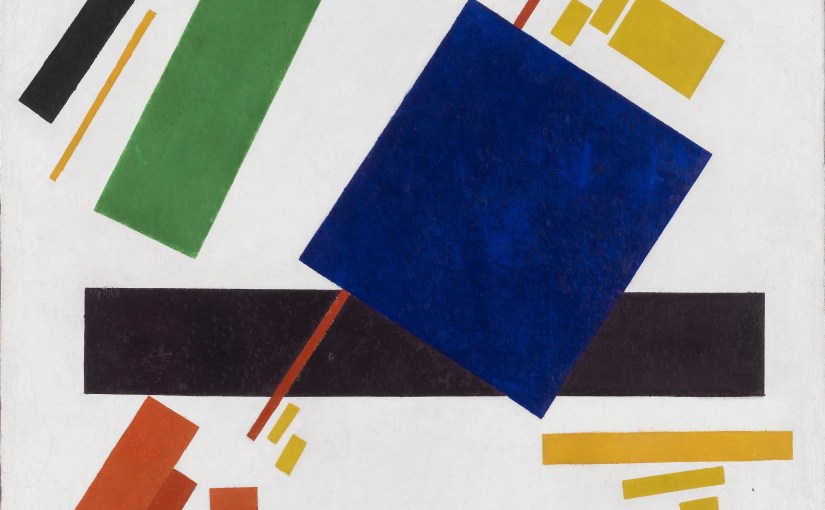
Credit : to the defunct Kazimir Malevich, Supermatist Composition, 1916

Math as Myth

A great song, Golden Ratio, and artwork from Benn Watt’s album. 

But simple, beautiful mathematical explanations can make us greedy. While we wish for all explanations of the world around us to be elegant, science often involves “the slaying of a beautiful hypothesis by an ugly fact,” in the words of biologist Thomas Henry Huxley. Before positing elliptical orbits, Kepler himself succumbed to the desire for beauty when he suggested that the planets’ orbits could be modeled as the Platonic solids nested inside each other. His theory was beautiful, but it was soundly disproved by later observations of the outer planets. In a way, it was almost too beautiful to be right.

→ Nautilus

Mr. Bleu

ikb128

Delighted to hear Bill Gross’ point of view regarding art collecting. He and his wife seem more impressed by stamps, which they’re renowned collectors.

I’ve never been much of an art aficionado myself, having settled for framing some All American Rockwells neatly clipped from old Saturday Evening Post covers. There was a time though when a well-publicized Rockwell came to auction and Sue and I expressed some interest. Ever since, we’ve been on the art house’s mailing lists and I must admit, it’s fun to browse through the Picassos, Rothkos, and whatever else currently frenzies modern collectors. I’m no expert though, and if I begin to pretend that I am, Sue puts me in my place because she’s the artist in the family. She likes to paint replicas of some of the famous pieces, using an overhead projector to copy the outlines and then just sort of fill in the spaces. “Why spend $20 million?” she’d say – “I can paint that one for $75”, and I must admit that one fabulous Picasso with signature “Sue”, heads the fireplace mantle in our bedroom

→ Janus Capital

A History of ETA

A brief history of the most infamous and highly distributed Swiss movement. 

The last we checked, the deadline was somewhere out in 2019 (2023 for Nivarox hairsprings – a much more difficult technology to reproduce).

And thus, ETA has become the little (watch) engine that could, that did, and now won’t for much longer.

→ Worn&Wound

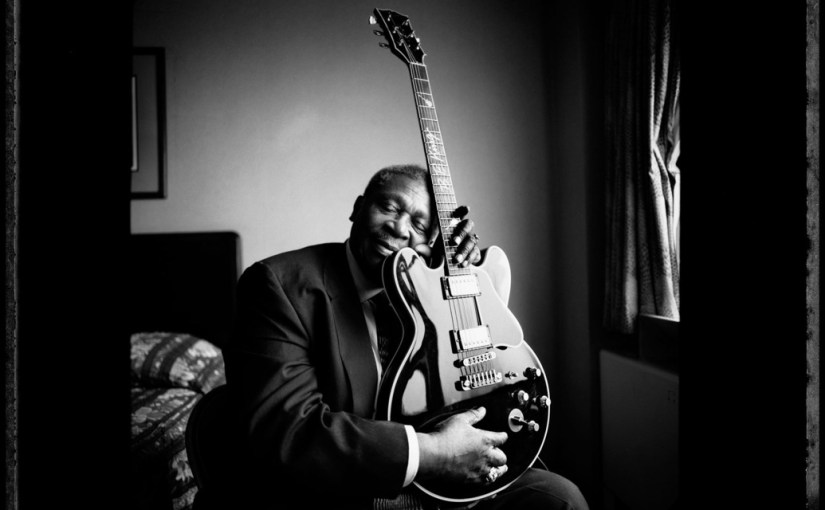
B. B. King, Defining Bluesman for Generations

The thrill is not yet gone as he helped pave the way to great artists and inspired many more to keep up the fight. 

“Growing up on the plantation there in Mississippi, I would work Monday through Saturday noon,” he said. “I’d go to town on Saturday afternoons, sit on the street corner, and I’d sing and play.

“I’d have me a hat or box or something in front of me. People that would request a gospel song would always be very polite to me, and they’d say: ‘Son, you’re mighty good. Keep it up. You’re going to be great one day.’ But they never put anything in the hat.

“But people that would ask me to sing a blues song would always tip me and maybe give me a beer. They always would do something of that kind. Sometimes I’d make 50 or 60 dollars one Saturday afternoon. Now you know why I’m a blues singer.”

And from the New Yorker :

That tension in his music—it was, in retrospect, I suppose, a play between a jazz ear and a blues hand, and even between the city and the country—paid off in a quality that I recognized at once that night, though I might not have known the word for it. It was the thing that marked him off from all those earnest English pasticheurs: B. B. King swung.

Credit : Danny Clinch

→ The New York Times