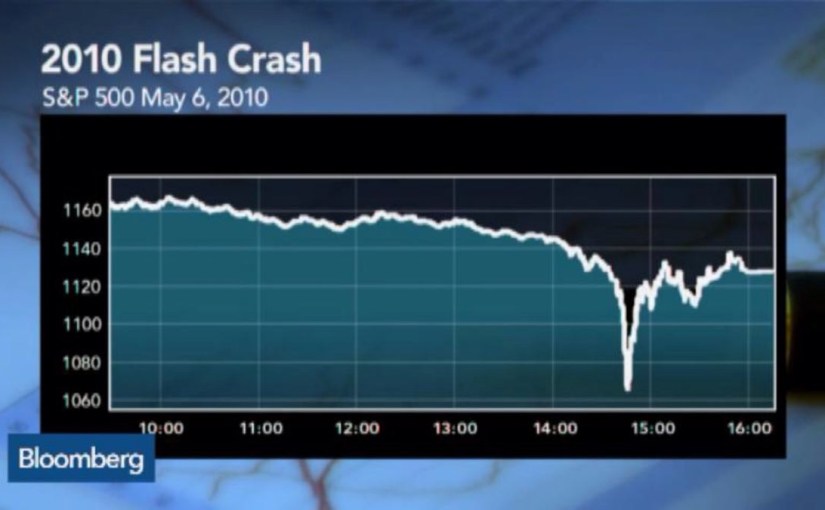
How a Mystery Trader With an Algorithm May Have Caused the Flash Crash

That same day, Sarao and his firm, Nav Sarao Futures Limited Plc, used “layering” and “spoofing” algorithms to trade thousands of futures S&P 500 E-mini contracts. The orders amounted to about $200 million worth of bets that the market would fall, a trade that represented between 20 percent and 29 percent of all sell orders at the time. The orders were then replaced or modified 19,000 times before being canceled in the afternoon.

About three weeks later, Sarao told his broker that he had just called the CME and told them to “kiss my ass,” the affidavit said.

→ Bloomberg

Birdman : The Pigeon King and the Ponzi Scheme

In a typical Ponzi scheme, like Bernie Madoff’s, the scammer moves money between investors, to pay what he claims are dividends on an investment that doesn’t actually exist. But Galbraith didn’t have a fake investment as a front. He had birds — lots of birds, and those birds created more birds, which he, in turn, was obligated to buy, then house, feed, water and medicate at considerable cost until he could sell them off to someone else. He appeared to miss the whole point of a Ponzi: He took the hidden, fungible fictions that give the scam its power and turned them into tangible liabilities.

→ The New York Times

Overnight vs. Intraday Expected Returns

IMG_1378
Panel A lists the close-to-close returns of the momentum strategy. As discussed above, close-to-close return equals the sum of the overnight return and the intraday return. Momentum seems to show up in close-to-close returns. Panel B shows the main result of this paper: Almost ALL of the abnormal returns in the momentum strategy are generated overnight, rather than intraday.

→ Alpha Architect

The NYTimes Could Be Worth $19bn Instead Of $2bn

IMG_1358

Frédéric Filloux :

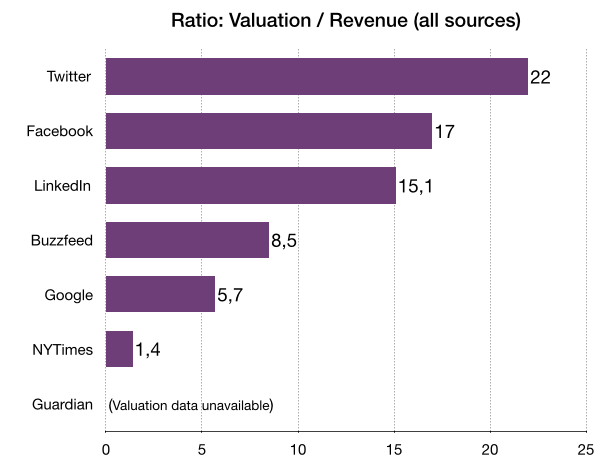
Through this lens, if Wall Street could assign to The New York Times the ratio Silicon Valley grants BuzzFeed (8.5 instead of a paltry 1.4), the Times would be worth about $19bn instead of the current $2.2bn.

Again, there is no doubt that Wall Street would respond enthusiastically to a major shrinkage of NYTCo’s print operations; but regardless of the drag caused by the newspaper itself, the valuation gap is absurdly wide when considering that 75% of BuzzFeed traffic is actually controlled by Facebook, certainly not the most reliably unselfish partner.

While BuzzFeed relies on ridiculous headlines and traffic from Facebook, investors are more inclined to value BuzzFeed way higher than the Times because of the potential it can generate in the future.

On the other hand, the Times is a safe-house, which proved to be realistic 5-7 years ago by transitioning into a successful digital brand. So all in all, the growth of Times is less tangible than a relatively new website. That’s precisely why there’s such a gap between the two. Though to be perfectly realistic, considering that one is kinda overvalued and the other one undervalued (in Silicon Valley standard) these two ratios should adjust and get closer together.

→ Monday Note