Game Theory Calls Cooperation Into Question

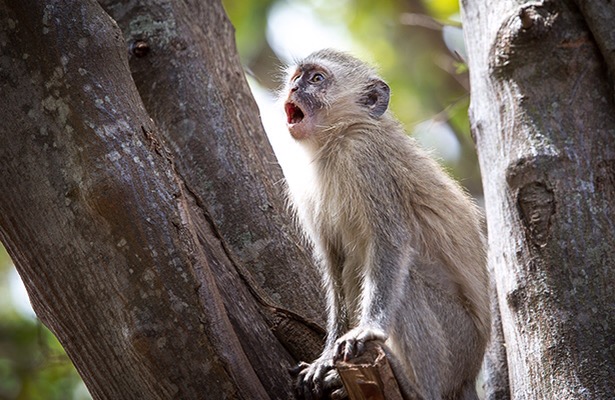
Vervet monkeys are known for their alarm calls. A monkey will scream to warn its neighbors when a predator is nearby. But in doing so, it draws dangerous attention to itself. Scientists going back to Darwin have struggled to explain how this kind of altruistic behavior evolved. If a high enough percentage of screaming monkeys gets picked off by predators, natural selection would be expected to snuff out the screamers in the gene pool. Yet it does not, and speculation as to why has led to decades of (sometimes heated) debate.

Researchers have proposed different possible mechanisms to explain cooperation. Kin selection suggests that helping family members ultimately helps the individual. Group selection proposes that cooperative groups may be more likely to survive than uncooperative ones. And direct reciprocity posits that individuals benefit from helping someone who has helped them in the past.


→ Quanta Magazine

The Anti-Information Age

Myself, I sometimes think that I’d gladly censor what’s coming out from the tubes — what you get access to can be so depressing and conflicting with our own beliefs.

No place shows the contradictions of this contest on as grand a scale as China does. The country with the most Internet users and the fastest-growing connected population is also the world’s most ambitious censor. Of the 3 billion Internet users on the planet, 20 percent live in China (10 percent live in the U.S.). The government maintains the “Great Firewall” to block unacceptable content, including foreign news sites. An estimated 2 million censors police the Internet and the activities of users. Yet a 2014 BBC poll found that 76 percent of Chinese reported feeling free from government surveillance. This was the highest rate of the 17 countries surveyed.

→ The Atlantic

The Epidemic of Facelessness

The Gyges effect :

When the police come to the doors of the young men and women who send notes telling strangers that they want to rape them, they and their parents are almost always shocked, genuinely surprised that anyone would take what they said seriously, that anyone would take anything said online seriously. There is a vast dissonance between virtual communication and an actual police officer at the door. It is a dissonance we are all running up against more and more, the dissonance between the world of faces and the world without faces. And the world without faces is coming to dominate.

→ The New York Times

Solving an Unsolvable Math Problem

In “The Psychology of Invention in the Mathematical Field,” published in 1945, Jacques Hadamard quotes a mathematician who says, “It often seems to me, especially when I am alone, that I find myself in another world. Ideas of numbers seem to live. Suddenly, questions of any kind rise before my eyes with their answers.” In the back yard, Zhang had a similar experience. “I see numbers, equations, and something even—it’s hard to say what it is,” Zhang said. “Something very special. Maybe numbers, maybe equations—a mystery, maybe a vision. I knew that, even though there were many details to fill in, we should have a proof. Then I went back to the house.”

→ The New Yorker

Reality = Normal + Fat-Tail Distributions

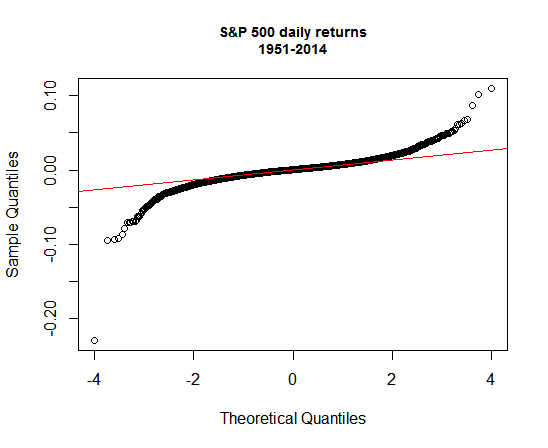
To illustrate the phenomenon, consider the S&P’s daily percentage returns in terms of quantiles, which divides the performance record into equal-sized portions. The graph below plots the sample return of the S&P (black circles) against the theoretical quantiles (red line), defined here by a random distribution. If the S&P’s daily returns were perfectly random, the black circles would match the red line.

sp.a.25sep2014

Normal distributions are still useful for analyzing markets and designing portfolios. Indeed, even in the daily return plot above it’s clear that the distribution looks quite normal for a fair amount of the sample. We can’t rely on normality alone for modeling markets. Factoring in fat-tails risk is essential. But letting a fat-tail worldview dominate your analysis is every bit as flawed as assuming that normal distributions will prevail. Asset pricing doesn’t neatly fit into one theoretical box, which means that our analytical tool kit shouldn’t be in a conceptual straightjacket either.

→ The Capital Spectator