
In “The Psychology of Invention in the Mathematical Field,” published in 1945, Jacques Hadamard quotes a mathematician who says, “It often seems to me, especially when I am alone, that I find myself in another world. Ideas of numbers seem to live. Suddenly, questions of any kind rise before my eyes with their answers.” In the back yard, Zhang had a similar experience. “I see numbers, equations, and something even—it’s hard to say what it is,” Zhang said. “Something very special. Maybe numbers, maybe equations—a mystery, maybe a vision. I knew that, even though there were many details to fill in, we should have a proof. Then I went back to the house.”
Category: Life
Reality = Normal + Fat-Tail Distributions
To illustrate the phenomenon, consider the S&P’s daily percentage returns in terms of quantiles, which divides the performance record into equal-sized portions. The graph below plots the sample return of the S&P (black circles) against the theoretical quantiles (red line), defined here by a random distribution. If the S&P’s daily returns were perfectly random, the black circles would match the red line.
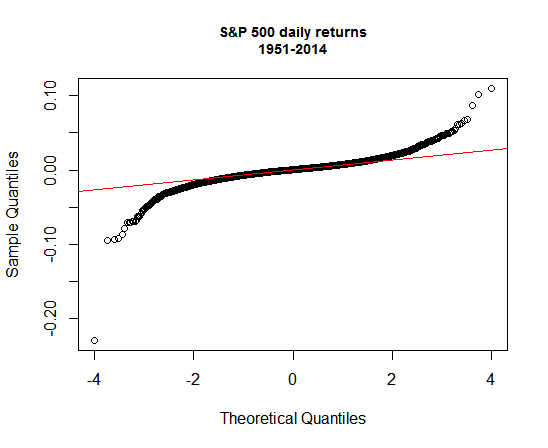
Normal distributions are still useful for analyzing markets and designing portfolios. Indeed, even in the daily return plot above it’s clear that the distribution looks quite normal for a fair amount of the sample. We can’t rely on normality alone for modeling markets. Factoring in fat-tails risk is essential. But letting a fat-tail worldview dominate your analysis is every bit as flawed as assuming that normal distributions will prevail. Asset pricing doesn’t neatly fit into one theoretical box, which means that our analytical tool kit shouldn’t be in a conceptual straightjacket either.
I’m a Cop. If You Don’t Want to Get Hurt, Don’t Challenge Me.
Even though it might sound harsh and impolitic, here is the bottom line: if you don’t want to get shot, tased, pepper-sprayed, struck with a baton or thrown to the ground, just do what I tell you. Don’t argue with me, don’t call me names, don’t tell me that I can’t stop you, don’t say I’m a racist pig, don’t threaten that you’ll sue me and take away my badge. Don’t scream at me that you pay my salary, and don’t even think of aggressively walking towards me. Most field stops are complete in minutes. How difficult is it to cooperate for that long?
US Education: How We Got Where We Are Today
“A Nation at Risk,” commissioned by the Reagan administration in 1981, was a scathing appraisal of public education. Its authors – a federal commission of leaders from government, business, and education – spent two years examining American schools, and they were appalled at what they found. Standardized test and SAT scores were falling. The United States was dropping behind competitors such as Japan. The public education system was so bad that not only were US students unprepared to join an increasingly high-tech workforce, 23 million Americans were functionally illiterate. Worst of all, the report concluded, Americans were complacent as their schools crumbled, threatening the very “fabric of society.”
One of the most famous lines in the report said: “If an unfriendly foreign power had attempted to impose on America the mediocre educational performance that exists today, we might well have viewed it as an act of war.”
The Economics of Pricelessness
As Exhibit A, I give you Apple during the reign of Steve Jobs at the top of the Apple reputation economy. That Apple at the time was primarily a reputation economy, and only secondarily a computing hardware market, is clear from the fact that there is a clear hierarchy in its market, with users at the bottom, genius-bar reps one level up, and an invisible secret church in the background with Jobs at the top. Now that he’s gone, the fate of the company depends on the ability of Tim Cook to play St. Peter well.

