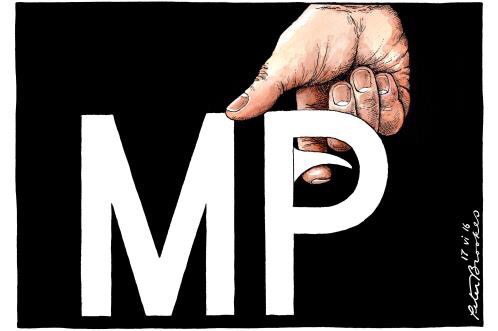
Jo felt being an MP mattered. She was right


I am tired beyond words of the cynical nonsense spouted every day by professional pundits (as well as amateur ones) that politicians are just in it for themselves, want nothing other than glory or the opportunity to fiddle bath plugs on their parliamentary expenses. Attention must be paid. Most MPs, of all parties, are decent people doing a tough job as well as they can.

When do we ever stop to applaud the manifold virtues of our politics? Why are we so receptive to the calumny that politicians are habitual liars? Jo Cox has been added, senselessly and without compensating progress, to the roll-call of people who lost their lives doing a democratic duty.


→ The Times

The Man Who Terrifies Wall Street

Bharara argues that publicizing criminal behavior is a public duty, for the purpose of deterrence. “It’s not my job to put out a ten-point program to fix corruption in New York State,” Bharara told me. “Prosecutors alone are not going to solve the problems. But we do want the problems to be solved. I can say that when you have an overabundance of outside income for legislators, when you have an overconcentration of power in the hands of a few people, and when you have a lack of transparency about how decisions are made and who makes them—that it is our job to point that out. We can give these issues a sense of urgency. A lot of people wake up to the possibility of better government when you start putting people in prison.”

→ The New Yorker

Disgraced Trader’s Struggle for Redemption

“It’s not necessarily about money, it’s about winning,” he told a visiting group of American college students. He told them that to understand trading, they needed to forget everything they learned in economics class and envision the amoral, take-no-prisoners world of “The Hunger Games.”

“The only time when people cooperate is to prolong their own lives,” he said. When rivals are no longer useful, “you stab them in the back.”

He told students he had accepted the fact that he was a rogue trader—but in his telling, it didn’t sound all that sinister.

A rogue trader, he said, “is a risk taker. It’s not a crime. It’s violating the mores established by the institution that you work for. It’s a rebellion against institutional controls that deny individuals opportunities for self-actualization.”

→ The Wall Street Journal

The Secret History of One Hundred Years of Solitude

Stuck up on the wall were charts of the history of a Caribbean town he called Macondo and the genealogy of the family he named the Buendías. Outside, it was the 1960s; inside, it was the deep time of the pre-modern Americas, and the author at his typewriter was all-powerful.

He visited a plague of insomnia upon the people of Macondo; he made a priest levitate, powered by hot chocolate; he sent down a swarm of yellow butterflies. He led his people on the long march through civil war and colonialism and banana-republicanism; he trailed them into their bedrooms and witnessed sexual adventures obscene and incestuous. “In my dreams, I was inventing literature,” he recalled. Month by month the typescript grew, presaging the weight that the great novel and the “solitude of fame,” as he would later put it, would inflict on him.

→ Vanity Fair

Sean Parker : Hacker Philanthropist

Not your average pharma bro’ :

Hacker philanthropy is meant to be the antidote to what Parker calls the conservative, incremental work of most charitable foundations; a timidity he says is borne of institutional self-preservation and a need to assuage philanthropists’ “deep-seated anxiety that their capital may not be accomplishing anything”.

Hackers, by contrast, are iconoclasts drawn to fix the holes in big, complex systems, and they are willing to make bold experiments and embrace failure as a learning experience. Since the world’s billionaires lists are increasingly populated by computer programmers who have built insanely large tech companies, it is only a matter of time until their hacker mentality is brought into the world of philanthropy.

→ Financial Times