
Himself :
I don’t know if a Garden of Eden awaits adults in the hereafter. I do know, though, that there is a Garden of Eden for children here in this life. I know because I myself visited this paradise.
Himself :
I don’t know if a Garden of Eden awaits adults in the hereafter. I do know, though, that there is a Garden of Eden for children here in this life. I know because I myself visited this paradise.
A lovely story :
I wish I’d known her as a puppy. I picture her small enough to hold in your hand, and she’s with her brothers and sisters; they’re all normal little dogs and then there’s this tiny hunchback. Working at the shelter, I could adopt all the beautiful purebreds if I wanted to; but Quasi shows that you don’t need to be the most perfect-looking animal to be a loving pet. She gets on with all our other animals and cuddles up to one of our cats who likes sleeping with her.
I don’t feel sorry for her. She teaches people tolerance, especially those who initially stare, because they think she’s ugly or they’re afraid; she always wins them over. She’s taught me not to dwell on what’s wrong in life. She’s not self-conscious. She doesn’t look in the mirror and go, “Oh, poor me.” She’s the epitome of happiness.
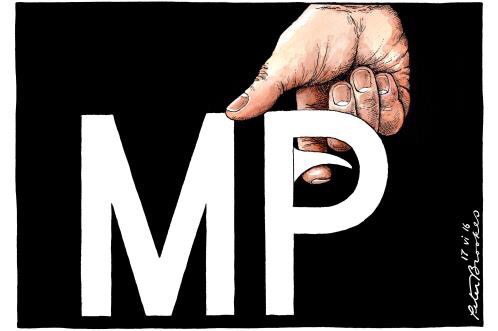
I am tired beyond words of the cynical nonsense spouted every day by professional pundits (as well as amateur ones) that politicians are just in it for themselves, want nothing other than glory or the opportunity to fiddle bath plugs on their parliamentary expenses. Attention must be paid. Most MPs, of all parties, are decent people doing a tough job as well as they can.
When do we ever stop to applaud the manifold virtues of our politics? Why are we so receptive to the calumny that politicians are habitual liars? Jo Cox has been added, senselessly and without compensating progress, to the roll-call of people who lost their lives doing a democratic duty.
Bharara argues that publicizing criminal behavior is a public duty, for the purpose of deterrence. “It’s not my job to put out a ten-point program to fix corruption in New York State,” Bharara told me. “Prosecutors alone are not going to solve the problems. But we do want the problems to be solved. I can say that when you have an overabundance of outside income for legislators, when you have an overconcentration of power in the hands of a few people, and when you have a lack of transparency about how decisions are made and who makes them—that it is our job to point that out. We can give these issues a sense of urgency. A lot of people wake up to the possibility of better government when you start putting people in prison.”
“It’s not necessarily about money, it’s about winning,” he told a visiting group of American college students. He told them that to understand trading, they needed to forget everything they learned in economics class and envision the amoral, take-no-prisoners world of “The Hunger Games.”
“The only time when people cooperate is to prolong their own lives,” he said. When rivals are no longer useful, “you stab them in the back.”
He told students he had accepted the fact that he was a rogue trader—but in his telling, it didn’t sound all that sinister.
A rogue trader, he said, “is a risk taker. It’s not a crime. It’s violating the mores established by the institution that you work for. It’s a rebellion against institutional controls that deny individuals opportunities for self-actualization.”