Roubini Says The Art Market Is Rigged

Yet another rigged market, according to Nouriel Roubini, the man who predicted the housing crisis. As recent regulation and scandals make it harder to hide money from the eyes of institutions (and whistleblowers), capitals quietly move from tax-havens safes to renowned auction houses, valuing the entire market of public sales to $16.4bln in 2014 (approx. $70bln including private sales), more than four times the highs of a decade ago. The same can be told for the watch after-market too, though the numbers are much lower and highly concentrated between Rolex and Patek.

In another article, Mr. Roubini emphasis that Art is an asset class as a whole that needs to be regulated like other capital markets are.

But without further ado, John Gapper and Peter Aspden :

Regulation is needed in the art market because it is vulnerable to money laundering, tax evasion, trading on inside information and price manipulation, says one of the world’s most respected economists.
→ Financial Times

Fast Traders Are Getting Data From SEC Seconds Early

The SEC uses Tradeworx datas to analyze the market and causes of flashcrashes, while high-frequency traders get a prime access to the SEC’s datas to place bets. Fair trade.

Hedge funds and other rapid-fire investors can get access to market-moving documents ahead of other users of the Securities and Exchange Commission’s system for distributing company filings, giving them a potential edge on the rest of the market.

→ WSJ

Revisiting the Lehman Brothers Bailout That Never Was

Inside the Federal Reserve Bank of New York, time was running out to answer a question that would change Wall Street forever.

At issue that September, six years ago, was whether the Fed could save a major investment bank whose failure might threaten the entire economy.

The firm was Lehman Brothers. And the answer for some inside the Fed was yes, the government could bail out Lehman, according to new accounts by Fed officials who were there at the time.

***

Those teams had provisionally concluded that Lehman might, in fact, be a candidate for rescue, but members of those teams said they never briefed Mr. Geithner, who said he did not know of the results.

→ The New York Times

Inside the New York Fed: Secret Recordings and Culture Clash

The audio is muddy but the words are distinct. So is the tension. Segarra is in Silva’s small office at Goldman Sachs with his deputy. The two are trying to persuade her to change her view about Goldman’s conflicts policy.

“You have to come off the view that Goldman doesn’t have any kind of conflict-of- interest policy,” are the first words Silva says to her. Fed officials didn’t believe her conclusion — that Goldman lacked a policy — was “credible.”

And here is the audio report from This American Life.

→ ProPublica

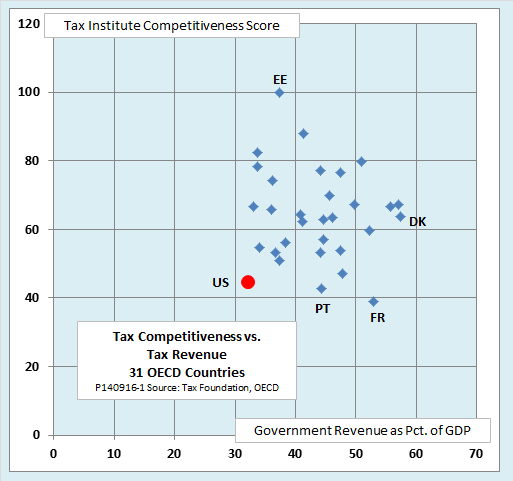
Everything That’s Wrong with the US/French Tax System in One Chart

P140916-1

Think about it. It is not surprising that the corporate citizens of France view their country’s tax system as burdensome. After all, France has to feed a huge government sector that swallows up revenue equal to 53 percent of GDP, and still runs a budget deficit of more than 3 percent. Yet the US tax system manages to be nearly as uncompetitive as that of France while raising 40 percent less revenue.

Or compare the United States to Denmark, whose government collects the most revenue of any of its OECD peers—57.4 percent of GDP. You would think such a massive tax take would render Denmark radically uncompetitive, but instead, its Tax Institute score is 43 percent higher than that of the United States, close to the OECD average.

→ EconoMonitor