Big Data’s Mathematical Mysteries

At a dinner I attended some years ago, the distinguished differential geometer Eugenio Calabi volunteered to me his tongue-in-cheek distinction between pure and applied mathematicians. A pure mathematician, when stuck on the problem under study, often decides to narrow the problem further and so avoid the obstruction. An applied mathematician interprets being stuck as an indication that it is time to learn more mathematics and find better tools.

I have always loved this point of view; it explains how applied mathematicians will always need to make use of the new concepts and structures that are constantly being developed in more foundational mathematics. This is particularly evident today in the ongoing effort to understand “big data” — data sets that are too large or complex to be understood using traditional data-processing techniques.

Our current mathematical understanding of many techniques that are central to the ongoing big-data revolution is inadequate, at best. Consider the simplest case, that of supervised learning, which has been used by companies such as Google, Facebook and Apple to create voice- or image-recognition technologies with a near-human level of accuracy. These systems start with a massive corpus of training samples — millions or billions of images or voice recordings — which are used to train a deep neural network to spot statistical regularities. As in other areas of machine learning, the hope is that computers can churn through enough data to “learn” the task: Instead of being programmed with the detailed steps necessary for the decision process, the computers follow algorithms that gradually lead them to focus on the relevant patterns.
→ Quanta Magazine

Algorithms Need Managers, Too


In Shakespeare’s Julius Caesar, a soothsayer warns Caesar to “beware the ides of March.” The recommendation was perfectly clear: Caesar had better watch out. Yet at the same time it was completely incomprehensible. Watch out for what? Why? Caesar, frustrated with the mysterious message, dismissed the soothsayer, declaring, “He is a dreamer; let us leave him.” Indeed, the ides of March turned out to be a bad day for the ruler. The problem was that the soothsayer provided incomplete information. And there was no clue to what was missing or how important that information was.

Like Shakespeare’s soothsayer, algorithms often can predict the future with great accuracy but tell you neither what will cause an event nor why. An algorithm can read through every New York Times article and tell you which is most likely to be shared on Twitter without necessarily explaining why people will be moved to tweet about it. An algorithm can tell you which employees are most likely to succeed without identifying which attributes are most important for success.

→ Harvard Business Review

Who Funds the Future?

“The biggest outcomes come when you break your previous mental model. The black-swan events of the past forty years—the PC, the router, the Internet, the iPhone—nobody had theses around those. So what’s useful to us is having Dumbo ears.” A great V.C. keeps his ears pricked for a disturbing story with the elements of a fairy tale. This tale begins in another age (which happens to be the future), and features a lowborn hero who knows a secret from his hardscrabble experience. The hero encounters royalty (the V.C.s) who test him, and he harnesses magic (technology) to prevail. The tale ends in heaping treasure chests for all, borne home on the unicorn’s back.

→ The New Yorker

Reign of the Algorithm

Writers, remember: the more we play the algorithmic game, the more the algorithmic game plays us. (All hail the great Algorithm in the Cloud!)

Algorithm-oriented content is becoming ubiquitous. It doesn’t matter what you read or what topics you search for, a growing percentage of online material is designed ground-up for the acquisition of ‘Likes’ and the courtship of search engines. Food, politics, current affairs, cats, academia — everything. It doesn’t matter what you are interested in, there is an army of people writing about it with strategic intent to leverage the algorithmic landscape for their advantage.

→ James Shelley

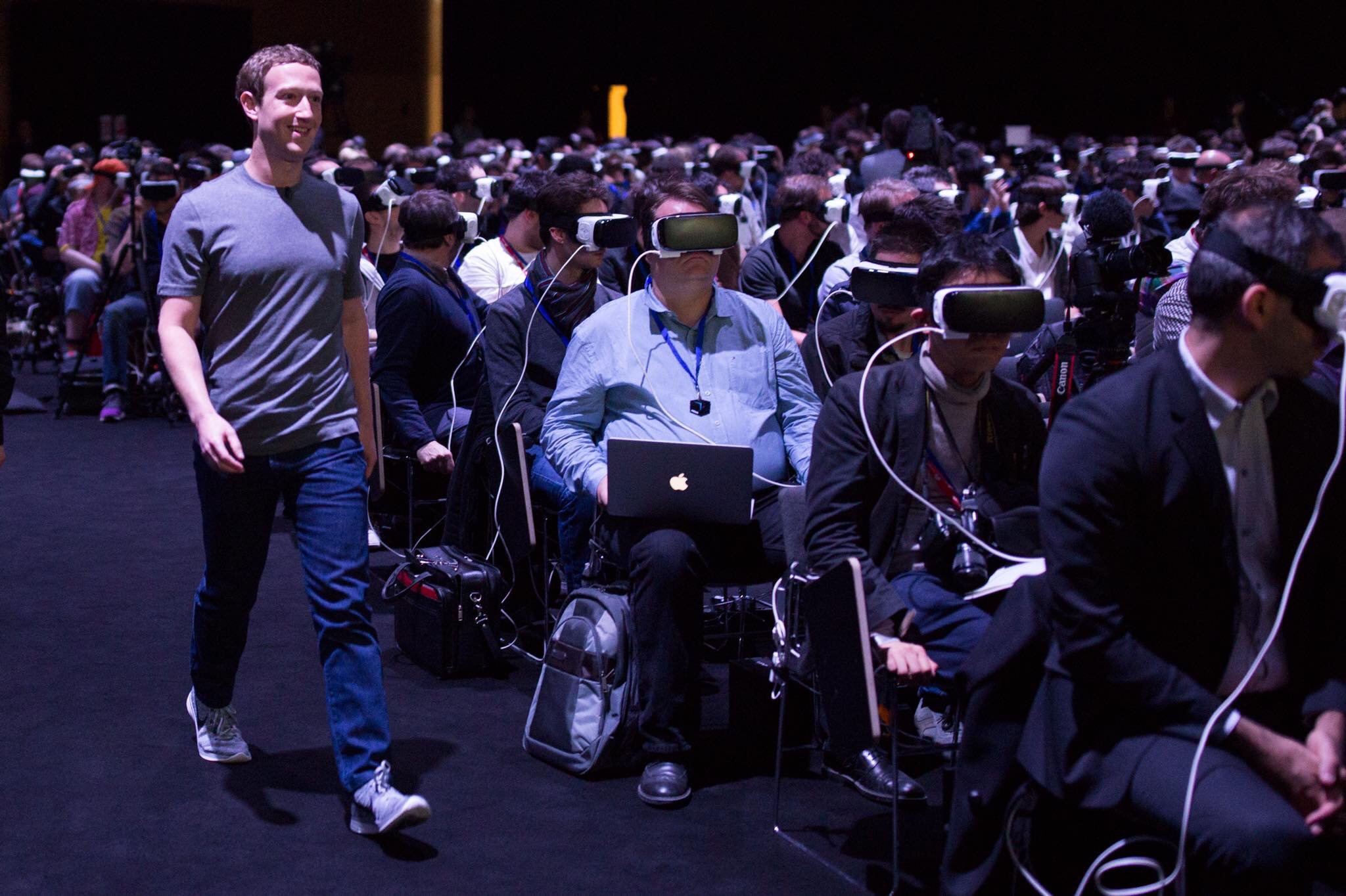
This Image Of Mark Zuckerberg Says So Much About Our Future


The image above looks like concept art for a new dystopian sci-fi film. A billionaire superman with a rictus grin, striding straight past human drones, tethered to machines and blinded to reality by blinking plastic masks. Golden light shines down on the man as he strides past his subjects, cast in gloom, toward a stage where he will accept their adulation. Later that night, he will pore across his vast network and read their praise, heaped upon him in superlatives, as he drives what remains of humanity forward to his singular vision.

→ The Verge