Apple Is Selling You A phone, Not Civil Liberties

Let’s start with an important fact that Apple elides in its statement: Apple engineered this problem and it did so intentionally. In the wake of the Snowden leaks, Apple specifically decided to encrypt material end-to-end and at rest by default on the devices it manufactures and to not maintain any ability to decrypt material unless users specifically gave it the power to recover that material. It boasted about this decision and used it as a marketing weapon against its competitors. Reasonable people can argue about whether or not Apple did so for good reasons and whether or not doing so was the optimal way for the company to enhance the cybersecurity of its users. But the simple fact remains that Apple used to have the capacity to comply with warrants, and now it cannot without a certain amount of reengineering. And that was a matter of its own choosing made despite repeated warnings from the government that this choice would cause substantial problems for law enforcement, national security investigators, and public safety.

• • •

FBI and Justice Department officials, we think, can be forgiven if they’re a touch cynical about all of Apple’s elaborate legal argumentation and suspect that this all just masks what appears to be Apple’s genuine litigating posture towards the government: You can’t make us do anything, because we are immensely politically powerful, our CEO is on the phone with the President regularly, we are too big and way too cool to fail, and people around the world like us more than they like you. So what about that dead woman in Louisiana? Sorry, but bringing her killer to justice—and preventing his or her future violence—just isn’t as important as the data security of our devices. And about protecting people from ISIS? We’ll help out if it’s not too much trouble, but don’t ask us—ever—to do something that will make us look bad to the ACLU, even if there’s a very good legal argument that you can.
→ Brookings

The Most Important Apple Executive You’ve Never Heard Of

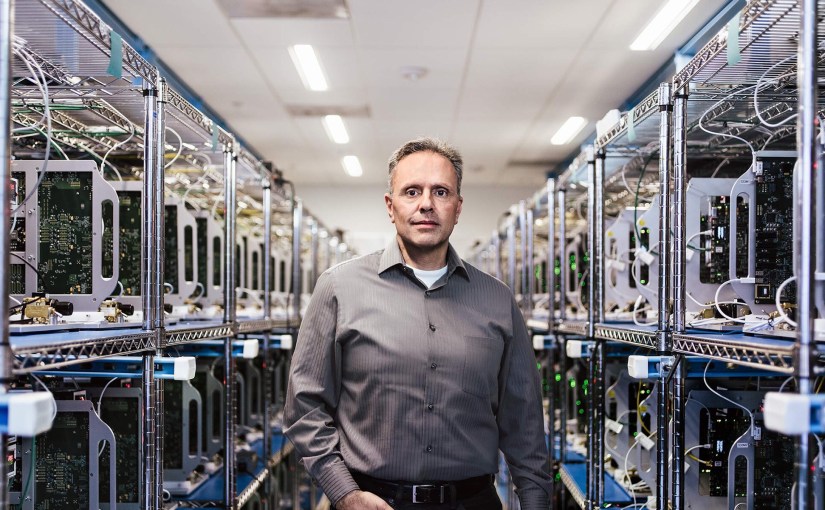
At the center of all this is Srouji, 51, an Israeli who joined Apple after jobs at Intel and IBM. He’s compact, he’s intense, and he speaks Arabic, Hebrew, and French. His English is lightly accented and, when the subject has anything to do with Apple, nonspecific bordering on koanlike. “Hard is good. Easy is a waste of time,” he says when asked about increasingly thin iPhone designs. “The chip architects at Apple are artists, the engineers are wizards,” he answers another question. He’ll elaborate a bit when the topic is general. “When designers say, ‘This is hard,’ ” he says, “my rule of thumb is if it’s not gated by physics, that means it’s hard but doable.”

→ Bloomberg Businessweek

Growing Old, But Not Together

HP is splitting into two separate companies on the NYSE :

Founded by two tech guys in a garage in Palo Alto in 1939, the giant created by Bill Hewlett and Dave Packard is remembered as Silicon Valley’s original startup. In its heyday, its flair for innovation was unrivalled, and it devised technologies that shaped people’s work and personal lives, from calculators to cameras to computers. Today it is regarded as a has-been: a reminder of Silicon Valley’s past but not a beacon of its future.

→ The Economist

Why Your Phone Battery Is Rubbish

What about the rest of us? Can we expect our gadgets to last longer than a day any time soon? “As long as our batteries are based on a chemical reaction, we will have huge limitations,” Buchmann says. “The health of a battery is almost like the health of a living organism or human being. We have to take care of it.” Limer says: “I don’t think things will change much in 10 years. A realistic future to hope for is one where even in extreme heavy use you can get through a day without losing your battery.” Right now, he adds, what we have is “a battery stalemate”.

→ The Guardian

Activision to Buy Candy Crush’s King for $5.9bn

John Gruber on the acquisition :

They were only going to pay $1 billion, but then they got stuck on a couple of levels, bought some gold bars, and, well, here they are.

More to follow later today (maybe), but as a reminder, here’s a poignant statement from an indie developer allegedly ripped off by King.com :

Congratulations! You win! I created my game CandySwipe in memory of my late mother who passed away at an early age of 62 of leukemia. I released CandySwipe in 2010 five months after she passed and I made it because she always liked these sorts of games. In fact, if you beat the full version of the android game, you will still get the message saying “…the game was made in memory of my mother, Layla…” I created this game for warmhearted people like her and to help support my family, wife and two boys 10 and 4.

I have never downloaded nor played to any of their apps, I find them dumb and unaesthetic. In light of the previous statement I could only encourage you to remove them. 

Plus, I see mostly bored housewives or early teens playing Candy Crush, which makes the price of the acquisition even more insane. They are not real gamers like the core business of Activision-Blizzard, which is used to produce highly polished and immersive games. But I guess that’s where part of the money is to be made anyway and that’s sad. 

→ Financial Times