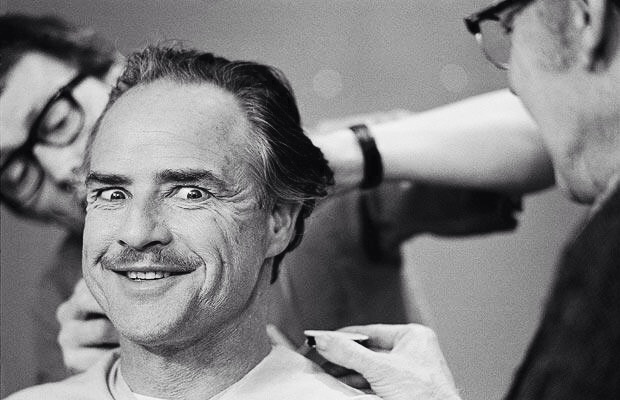
Marlon On Marlon… The Brando Tapes

Stevan Riley, the director of Listen To Me Marlon :

When Marlon was talking about acting, he’d say that your brain is your enemy. The first thing you must do is shut off your brain and just focus on feeling. It was about accessing emotions from the past for the character, which according to the method would involve you delving into your own past as well. Then, once you’d accessed the character emotionally, you’d bring your brain back in and figure out all the character’s mannerisms. The small details about what they eat, whether they’ve got fluff on their jumper they pick off on a regular basis – just tiny details you could stack, stack, stack so that they were there in your subconscious mind and you could then ditch them when the director said “Action!”

→ The Guardian

The Passion Of Nicki Minaj


There’s nothing new about female artists struggling with issues of power and control, but we’re far today from the 1990s, when Queen Latifah proclaimed ‘‘every time I hear a brother call a girl a bitch or a ho/Trying to make a sister feel low/You know all that gots to go.’’ ‘‘Bitch,’’ in music, used to be an insult, a sneer, and it still can be. But female empowerment is a trend, and the word has been reclaimed — by Minaj, in many a track; by Rihanna, in ‘‘Bitch Better Have My Money’’; and triumphantly by Madonna, in her recent track ‘‘Bitch, I’m Madonna.’’ This is good for business and either good for women or not good for women at all.

In another era, Minaj’s sexuality, expressed semi-parodically — pretending she’s a Barbie doll; glorifying women dressed as prostitutes and set in red-light-district windows — might have given feminists pause. But in the 2010s, we have entered a different world in pop culture, one in which sexual repression is perceived as burdensome and perhaps even an inability to holistically integrate the body and self. Young people are identifying and exploring formerly unknown, or at least unlabeled, frontiers of sexuality and gender. And the fact that Minaj is in charge of her own objectification (describing her vagina with more words than I thought existed, and then amplifying its power by rhyming those words), as well as her own monetization (overt product placement in videos is a hallmark) has led most feminist voices to applaud her.

→ The New York Times Magazine

Playboy Magazine Will No Longer Publish Nude Photo

The Internet has claimed one of its highest profile victims yet: As of March 2016, Playboy magazine will no longer feature fully nude models. This follows on from August last year, when the Playboy website also stopped publishing nude photos and videos. Yes, you’ll now be able to read Hugh Hefner’s flagship publication, which published its first nude centrefold way back in 1953, just for the articles.

Speaking to The New York Times, Playboy CEO Scott Flanders explained the reasoning behind the change: “You’re now one click away from every sex act imaginable for free. And so it’s just passé at this juncture.” Basically, Playboy stems from a time when nudity was racy and exciting; today, it’s de rigueur. The circulation figures illustrate that fact nicely: from a peak of around 5.6 million subscribers in 1975, Playboy is now down to around 800,000.

→ Ars Technica

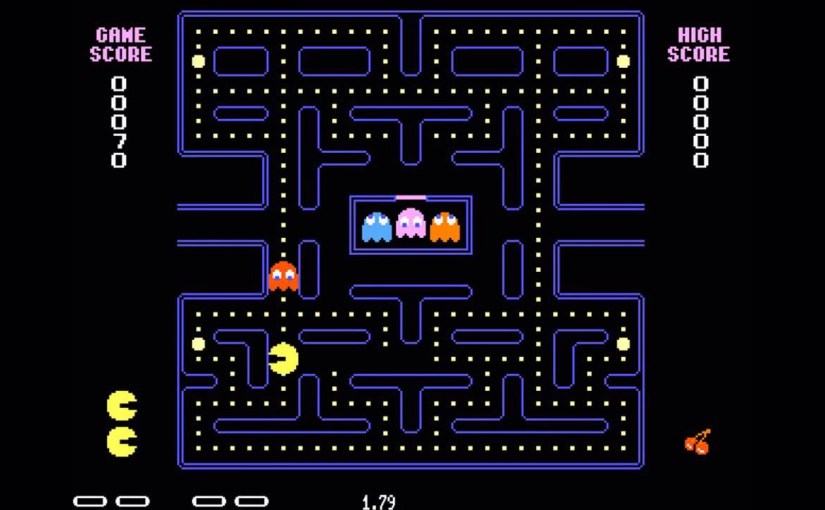
How Do The Ghosts In Pac-Man Decide Where To Go ?

The mathematics behind Pac-Man and the ghosts chasing him :

Put simply, Blinky is programmed to target whichever tile Pac-Man currently occupies, giving the illusion that he’s chasing the player. As the game progresses, Blinky’s speed increases to the point that he becomes marginally faster than Pac-Man at which point he becomes what fans refer to as “Cruise Elroy”. The exact number of dots you need to consume for Blinky to become Cruise Elroy depends on which level you’re currently playing, with the overall number dropping the further you get into the game to the point that he will assume Cruise Elroy form when there are still 60 dots left on screen. Blinky will momentarily cease being Cruise Elroy whenever the player loses a life.

→ Today I Found Out

The Age Of Loneliness

There’s just so much in this longform that I could not settle for just one or two paragraphs :

In the time I’d been gone, there had been a shift. Of course I had changed, and the trees had grown taller, but a greater swing—the kind that happens on a geological timescale of thousands or millions of years—was beginning to be widely acknowledged. Some scientists were becoming urgently vocal about the need to recognize that, in recent centuries, the world had entered a new epoch. They called it the Anthropocene. Planet Earth was now defined, they said, by the complete and utter dominance of human beings.

***

“It’s no longer us against ‘Nature,’” Paul Crutzen wrote in 2011. “Instead, it’s we who decide what nature is and what it will be.”

My favorite part — I love birds :

I stared down at my charge at the bottom of the basket. It was just a bird, but a bird that couldn’t be found anywhere on the East Coast forty years earlier, when DDT was so abundant that every falcon nest failed, the eggshells thinned beyond survival. This bird was hope. There in a room far above the famous Riverside Church sanctuary that gives so many people a place to put their faith, I looked into the bird’s dark eyes and found a place for my own.

A beautiful conclusion by Meera Subramanian. My thanks to her for this remarquable journey :

There is no trail going forward. We have to follow the lay of the land. We need to remember that when we leave the woods, it is not so easy to find our way back.

Credit : Steve McCurry, Canada

→ Guernica Magazine