The Writer and the Rebellion

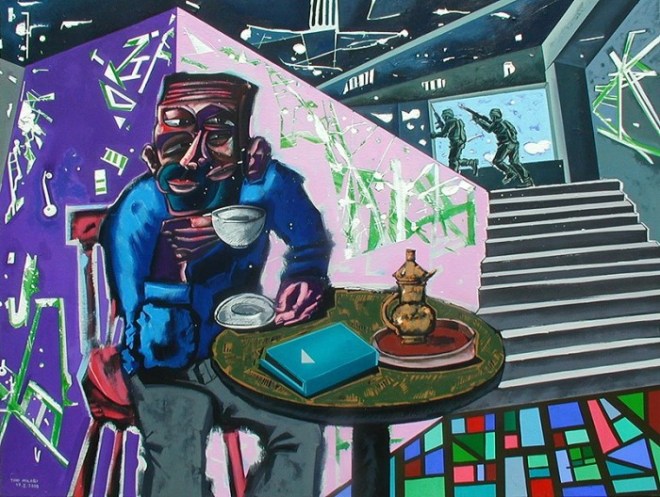
tonimilaqi5-086-11
Toni Milaqi, Coffe Time
July 2011 :

That evening, we went to George’s, Iowa City’s Qasabji: a dim, narrow bar of perpetual darkness. We met friends who still lived in town and drank and talked late into the night. “I think now, in Syria, we have a very new idea,” Khaled told me. “Now I’m writing my new novel. I have been writing for four years. But now, I will rewrite it, because I feel it is old writing. We have a new time, and new ideas, not just for writing but for the people too. Now we can understand our people. We are talking about this with young writers. What will be the future, I ask. You must be better. Because after the revolution you have new ideas about writing and about all art. We will have new ideas.”

→ Guernica Magazine

How I Used Maths To Beat The Bookies

There is a caveat to all of my modelling work, a small detail that I haven’t yet revealed. It is this. What I haven’t mentioned is that I had a fifth model. It was called “ask my wife”. Lovisa Sumpter is a very talented individual. She is an associate professor of mathematics education in Sweden, where we live, and a qualified yoga instructor. She also has a much better record than her husband in football betting. When she was still a student, Lovisa correctly predicted the outcome of every one of the 13 matches in the Swedish Stryktipset. The chance of getting these right by picking randomly is 1 in 3 to the power of 13 (or 1/1,594,323). Although the pay-out for her winning week was relatively small, she remains proud of being one of the few people in Sweden to “get 13 right”.

→ 1843 Magazine

What Tech’s Unicorn Cult Can Learn from the Art World

The art world knows about prices floating ever higher on abstraction and hope. The resonances aren’t completely coincidental. Both venture capitalists and art buyers are in the business of valuing the invaluable. Both stake their reputations on exquisite selection. Both nurture talent before it can support itself. Both have a soft spot for youth, for unbowed ego, for the myth of solitary genius, for the next new thing. Both operate in a world of frustratingly limited information and maddeningly unpredictable success. Both depend on consumer culture while holding themselves superior to it. And both the art market and venture investing have become increasingly winner-take-all games, with more clout to the companies and artists backed by the most powerful dealers or venture capitalists.

Credit : Harold Cunningham

→ The New Yorker