How to Fix a Monet After Somebody Punches It

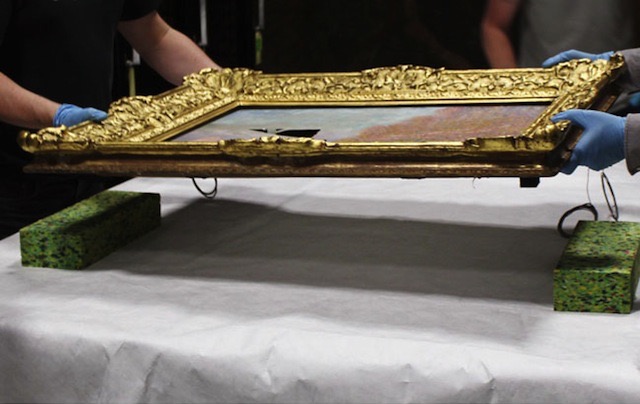
Conservators are probably the closest thing the art world has to surgeons. With care and precision, they repair wounds caused by old age, negligence, and, every once in a while, crazed attackers — as happened in 2012 to Claude Monet’s “Argenteuil Basin with a Single Sailboat.” Painted in 1874, it was punched by an angry madman as it hung in Ireland’s National Gallery.

The team tasked with repairing the artwork had their work cut out for them. The assailant had left a massive triangular tear in the middle of the canvas, and some of the paint had been so badly pulverized that it couldn’t be reattached. Over the course of two years, conservators worked carefully to repair the painting and restore it to its original condition. A true labor of love [abridged].

→ Hyperallergic

There’s No Such Thing as Triangles

Ever since you were little, you’ve seen triangles everywhere. You find them in jack-o’-lantern eyes, corporate logos, and grilled cheese sandwiches halved diagonally. They crop up in all kinds of construction projects: the pyramids, the supports beneath the Golden Gate Bridge, the tracks of roller coasters. When architects and engineers want a shape that’s sturdy and dependable, they turn to the triangle. There’s only one problem.

Triangles don’t exist.

I don’t mean to alarm you, and I hope I’m not spoiling any fond childhood memories of geometric forms. But triangles are like Santa Claus, the tooth fairy, and Beyoncé: too strange and perfect to exist in the actual world.

→ Math With Bad Drawings

Charlie Brown Never Found His Little Red-Haired Girl, but We Did

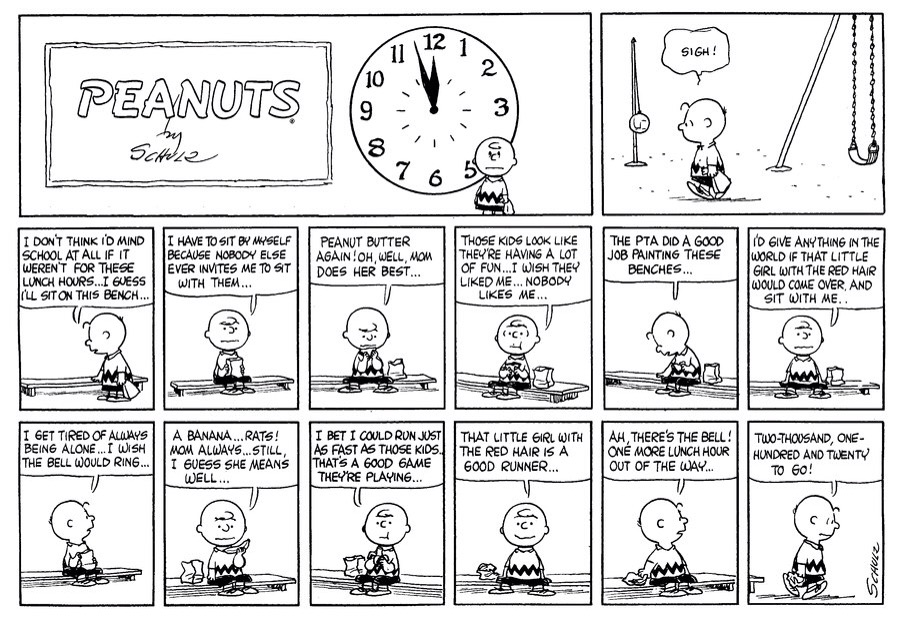
The romance between the artist, Charles Schulz, and his muse, the little girl with the red hair :

In the Peanuts Sunday strip that ran on November 19, 1961, Charlie Brown sits down to lunch, as usual, accompanied only by his abundant anxieties. He watches longingly as the other children enjoy themselves, laments his aloneness and unpopularity, and despairs over the lunch that he finds packed for him: a peanut-butter sandwich and a banana.

And, for the first time, he glimpses someone new in the schoolyard. “I’d give anything in the world if that little girl with the red hair would come over, and sit with me,” he says, to no one in particular.

→ Vanity Fair

Inside Job

A story on Raj Rajaratnam’s inside job and an unsuspected collateral damage:

In my many conversations with Das, I had failed to explain to her what insider trading was, how she ended up a millionaire on paper, and what her employer did in her name. Her sole source of aggrievement was the sum of Rs 8.5 lakh she believed Kumar owed her. Now, I heard her voice on the crackling line fill with hope. “Will he give me the two years’ pay he promised?” she asked. “If he does, that will be very good.” But, after a pause, she added, “If he does not, my life will continue.”

→ Caravan Magazine

The Invention Of The Wah-Wah Pedal

After a few days of fiddling around with spare parts, Plunkett succeeded in designing a circuit that could change the frequency of notes by simply rotating a potentiometer. Then, something unexpected happened:

“I went next door, and asked a friend of mine to plug a guitar into this pile of wires, resistors, and capacitors I had on the bench. He strummed a few chords while I turned the knob on the potentiometer. It went ‘WAH-WAH-WAH.’ We looked at each other, and said, ‘Wow! This is really great!’”

And it looks like this :

→ Priceonomics