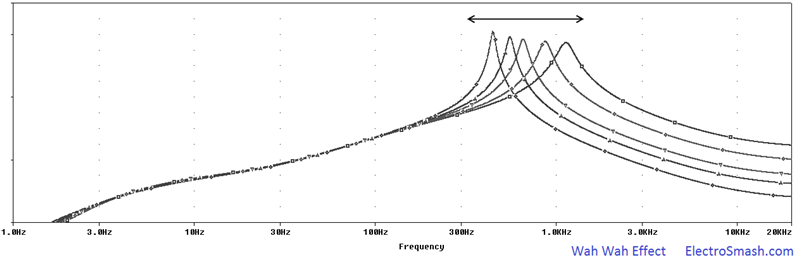
After a few days of fiddling around with spare parts, Plunkett succeeded in designing a circuit that could change the frequency of notes by simply rotating a potentiometer. Then, something unexpected happened:
“I went next door, and asked a friend of mine to plug a guitar into this pile of wires, resistors, and capacitors I had on the bench. He strummed a few chords while I turned the knob on the potentiometer. It went ‘WAH-WAH-WAH.’ We looked at each other, and said, ‘Wow! This is really great!’”
There are all kinds of theories about what makes a room sound good. One of the leading researchers in the field compares concert hall acoustics to tasting wine: some characteristics are easyily classifiable, but perception and taste are part of the equation, too. Another has suggested that understanding the way sound reflects in a room, not the shape of it, is the critical component to good concert hall design.
But the craziest theory comes from a researcher named Zackery Belanger. He thinks that acoustics is primarily a geometric problem, a theory so radical that he was forced out of his Ph.D. program because his advisor disagreed with it.
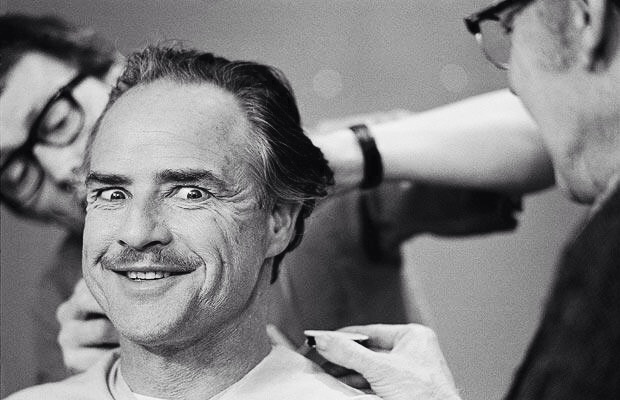
Stevan Riley, the director of Listen To Me Marlon :
When Marlon was talking about acting, he’d say that your brain is your enemy. The first thing you must do is shut off your brain and just focus on feeling. It was about accessing emotions from the past for the character, which according to the method would involve you delving into your own past as well. Then, once you’d accessed the character emotionally, you’d bring your brain back in and figure out all the character’s mannerisms. The small details about what they eat, whether they’ve got fluff on their jumper they pick off on a regular basis – just tiny details you could stack, stack, stack so that they were there in your subconscious mind and you could then ditch them when the director said “Action!”
There’s nothing new about female artists struggling with issues of power and control, but we’re far today from the 1990s, when Queen Latifah proclaimed ‘‘every time I hear a brother call a girl a bitch or a ho/Trying to make a sister feel low/You know all that gots to go.’’ ‘‘Bitch,’’ in music, used to be an insult, a sneer, and it still can be. But female empowerment is a trend, and the word has been reclaimed — by Minaj, in many a track; by Rihanna, in ‘‘Bitch Better Have My Money’’; and triumphantly by Madonna, in her recent track ‘‘Bitch, I’m Madonna.’’ This is good for business and either good for women or not good for women at all.
In another era, Minaj’s sexuality, expressed semi-parodically — pretending she’s a Barbie doll; glorifying women dressed as prostitutes and set in red-light-district windows — might have given feminists pause. But in the 2010s, we have entered a different world in pop culture, one in which sexual repression is perceived as burdensome and perhaps even an inability to holistically integrate the body and self. Young people are identifying and exploring formerly unknown, or at least unlabeled, frontiers of sexuality and gender. And the fact that Minaj is in charge of her own objectification (describing her vagina with more words than I thought existed, and then amplifying its power by rhyming those words), as well as her own monetization (overt product placement in videos is a hallmark) has led most feminist voices to applaud her.
Michael Ochs Archives
On the resurgence of one of my favorite artist :
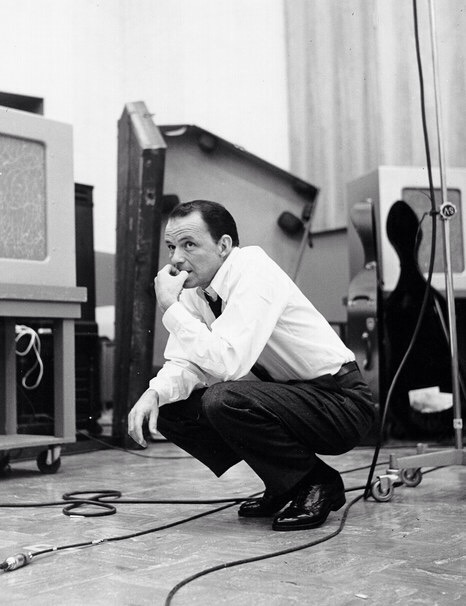
“He’s a dead man,” the talent agent Irving “Swifty” Lazar declared of Frank Sinatra in 1952. “Even Jesus couldn’t get resurrected in this town.” Maybe not, but Frank Sinatra could. Literally overnight—after the Academy Awards ceremony on March 25, 1954, where he won best actor in a supporting role for From Here to Eternity—Sinatra brought off the greatest comeback in show-business history. And he had done it all in Hollywood, a ruthlessly Darwinian company town that reviles losers but has the sappiest of soft spots for a happy ending. His Oscar underlined the fact that he was also a freshly viable recording artist with a new contract at Capitol Records, where he and a brilliant young arranger named Nelson Riddle had begun creating the string of groundbreaking recordings that would revolutionize popular music in the 1950s.
On a more personal level :
Frank’s restlessness—in his art, his personal relations, in everything—was his genius and his illness, and a permanent condition. There was always the dark undertow—the inner voices that told him that underneath it all he was nothing and nobody, a little street guinea from Hoboken. The furies that would frequently blind him when his vulnerabilities were touched. The terrible impatience—with the incompetence and stupidity that were so rife in the world, with things he needed to happen instantaneously, and so rarely did. The realization that he was like nobody else, and therefore destined to be alone. His terrors: of aloneness itself; of sleep, the cousin to death. And always, always, the vast and ravening appetites.



 Abnormal Capitalist