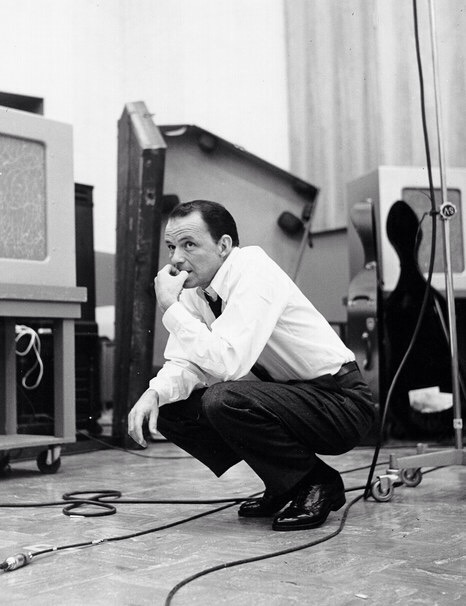
Frank Sinatra’s “I’ve Got You Under My Skin”

Michael Ochs Archives

On the resurgence of one of my favorite artist :

“He’s a dead man,” the talent agent Irving “Swifty” Lazar declared of Frank Sinatra in 1952. “Even Jesus couldn’t get resurrected in this town.” Maybe not, but Frank Sinatra could. Literally overnight—after the Academy Awards ceremony on March 25, 1954, where he won best actor in a supporting role for From Here to Eternity—Sinatra brought off the greatest comeback in show-business history. And he had done it all in Hollywood, a ruthlessly Darwinian company town that reviles losers but has the sappiest of soft spots for a happy ending. His Oscar underlined the fact that he was also a freshly viable recording artist with a new contract at Capitol Records, where he and a brilliant young arranger named Nelson Riddle had begun creating the string of groundbreaking recordings that would revolutionize popular music in the 1950s.

On a more personal level :

Frank’s restlessness—in his art, his personal relations, in everything—was his genius and his illness, and a permanent condition. There was always the dark undertow—the inner voices that told him that underneath it all he was nothing and nobody, a little street guinea from Hoboken. The furies that would frequently blind him when his vulnerabilities were touched. The terrible impatience—with the incompetence and stupidity that were so rife in the world, with things he needed to happen instantaneously, and so rarely did. The realization that he was like nobody else, and therefore destined to be alone. His terrors: of aloneness itself; of sleep, the cousin to death. And always, always, the vast and ravening appetites.


→ Vanity Fair

Was Steve Jobs An Artist ?

With the help of Marc Newson, this Mac Pro was auctionned $977’000.

“Art” is a capacious term. We typically imagine artists to be solitary people creating art by hand. But many artists work in more expansive, disembodied ways. We all recognize that film directors are artists, even though, in its substance, the work of directing often involves the management of teams and budgets on a corporate scale. Jeff Koons employs a hundred and fifty people, and the art works those workers create, at his direction, sell for tens of millions of dollars. Clearly, a vast distance separates Koons’s studio from the world of high-tech device manufacturing, but—at least in theory—the difference could be one of scale rather than kind. If a giant sculpture built to order by a team of employees can be a work of art, it’s at least possible that mass-produced computers could be art works, too.

→ The New Yorker

Art: An Alternative Asset Wealth Managers Can Do Without

“Making money is art,” Andy Warhol once wrote :

Another reason for advisers’ hesitance is the unique due diligence skillset that art fund investments require. Investors must evaluate the fund’s financial structure and its investment potential. Wealth managers can readily grasp the finance projections, but few are equipped to gauge the fund manager’s art market expertise, proposed acquisition market or strategy for buying and selling profitably, Beard notes.

→ Institutional Investors

A Feminist Version Of The Pirelli Calendar


A great initiative :

The show consists of 24 self-portraits shot by Marshall using a self-timer, 12 of which are glossy, sexually explicit images that channel those you might find in Pirelli or while leafing through the pages of Playboy, while the other 12 are raw, unadorned photos that express a femininity rarely observed in the mainstream media outside the occasional celebrity sans-makeup social media post.

Laid side-by-side, the contrast between these two women—who are in fact the same woman—is jarring. Both an homage to and a critique of the form it inhabits, “The Feminist Calendar” posits that perhaps these two aspects of womanhood aren’t as contradictory they seem.

→ Artnet