Regulators Bring a Strange Spoofing Case

When spoofing isn’t really spoofing :

One possibility is that Oystacher saw that the market didn’t look especially weak, and switched to being a buyer instead, betting that the price would go up. This story would not be about spoofing; it would be the opposite. In this story, Oystacher put in a big sell order, and then switched to being a buyer not because he saw tons of other sellers come in behind him, but because he saw so few sellers come in behind him (and so few buyers clear out in front of him). There weren’t that many sellers at the current offer (other than him), and there were a lot of buyers at the current bid, so he figured the price would go up.

→ Bloomberg View

How Much Money Does the 1% Have Hidden in Tax Havens?

Hard to tell how much, but according to Gabriel Zucman, the combined increased of tax havens is 25% since 2009 — when countries of the G20 held a summit in London and decreed the “end of banking secrecy.”

Accepting the status quo seems irresponsible. Each country has the right to choose its forms of taxation.But when Luxembourg offers tailored tax deals to multi-national companies, when the British Virgin Islands enables money launderers to create anonymous companies for a penny, when Switzerland keeps the wealth of corrupt elites out of sight in its coffers, they all steal the revenue of foreign nations. And they all win—fees, domestic activity, sometimes great influence on the international stage—while the rest of us lose. In the end, the taxes that are evaded have to be compensated for by higher taxes on the law-abiding, often middle-class households in the United States, Europe, and developing countries.

→ Naked Capitalism

Inflation Targeting And Expectations

Anchored expectations should be such that one perceives little risk of either high or low inflation in the future. Hence, the range of possible outcomes for inflation considered realistic by agents should be quite limited if expectations are well anchored, and their confidence in their forecasts should therefore be relatively high. To quantify this notion, we assessed the degree of uncertainty in New Zealand firms’ forecasts by asking managers to assign probabilities to a range of possible inflation outcomes. Using these distributions, we computed the standard deviation of each manager’s forecast. The average standard deviation is 2%, implying that firm managers have a lot of uncertainty around their forecasts. Furthermore, there is considerable heterogeneity in the degree of uncertainty associated with individuals’ forecasts.

→ VoxEu

Art: An Alternative Asset Wealth Managers Can Do Without

“Making money is art,” Andy Warhol once wrote :

Another reason for advisers’ hesitance is the unique due diligence skillset that art fund investments require. Investors must evaluate the fund’s financial structure and its investment potential. Wealth managers can readily grasp the finance projections, but few are equipped to gauge the fund manager’s art market expertise, proposed acquisition market or strategy for buying and selling profitably, Beard notes.

→ Institutional Investors

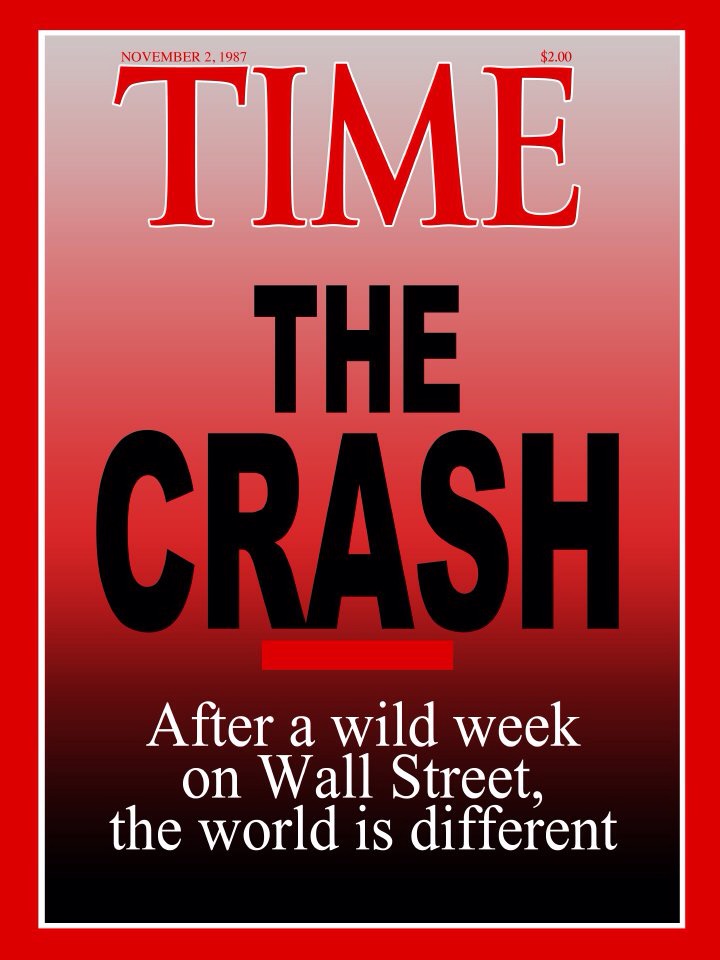
Black Monday Really Did Look Like 1929 Again


A short and informative recollection of what happened roughly three decades ago, from Barry Ritholtz :

Where were you on Monday, Oct. 19, 1987?

Today is the first time since 2009 that Oct. 19 has fallen on a Monday, and that has me thinking about that day. I recall exactly where I was — in graduate school, walking between classes, when I passed a television broadcasting the collapse.

New York Magazine had a great piece too on February 2008 :

It all started, of course, on Wall Street. On Black Monday, October 19, 1987, the Dow Jones index, for reasons still being debated, fell 508 points, almost a quarter of its total. (The current equivalent, for comparison’s sake, would be a 3,200-point loss on one day.) The drop turned out to be a “black swan event,” a weirdly poetic economist’s term meaning, basically, a fluke (though few people remember it, the Dow still eked out a positive finish for the year). Still, the hiccup seemed to foretell the instability to come. Over the next two years, with the economy perceived to be overheating, the Fed repeatedly jacked up interest rates, which made bonds and T-bills sexier than stocks, which triggered an epidemic of unscrupulous bond peddling, which further destabilized the market—leading to a slowdown. (If that all sounds disturbingly like the recent subprime-debt mess, well, that’s because it is. But more on that later.) And a slowdown on Wall Street, which provides over 20 percent of the city’s cash income, spells a slowdown for New York.

→ Bloomberg View