Ello, goodbye.

Aral is leaving Ello :

When you take venture capital, it is not a matter of if you’re going to sell your users, you already have. It’s called an exit plan. And no investor will give you venture capital without one. In the myopic and upside-down world of venture capital, exits precede the building of the actual thing itself. It would be a comedy if the repercussions of this toxic system were not so tragic.

Personally, I don’t really mind VCs selling my datas to advertisers and brands. That’s the price I’m willing to pay for a good service.

The other way to build a social service like this would be to set a subscription, like App.net does, though it has not proven to be very popular.

Now, how to maintain a service without funding ?

This is mythical. I think Aral’s note falls short without explaining his ideal way to fund a company and feed its employees.

Venture Capital might not be the perfect match between privacy and social medias, but I think it sustains creativity and encourage entrepreneurs to take risk — sometimes in creating some pixel-perfect layouts.
→ Aral Balkan

Reality = Normal + Fat-Tail Distributions

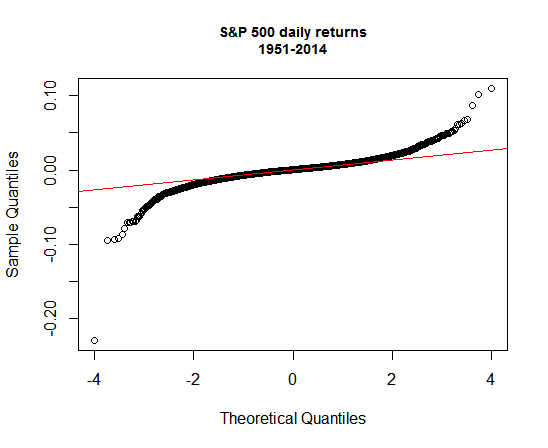
To illustrate the phenomenon, consider the S&P’s daily percentage returns in terms of quantiles, which divides the performance record into equal-sized portions. The graph below plots the sample return of the S&P (black circles) against the theoretical quantiles (red line), defined here by a random distribution. If the S&P’s daily returns were perfectly random, the black circles would match the red line.

sp.a.25sep2014

Normal distributions are still useful for analyzing markets and designing portfolios. Indeed, even in the daily return plot above it’s clear that the distribution looks quite normal for a fair amount of the sample. We can’t rely on normality alone for modeling markets. Factoring in fat-tails risk is essential. But letting a fat-tail worldview dominate your analysis is every bit as flawed as assuming that normal distributions will prevail. Asset pricing doesn’t neatly fit into one theoretical box, which means that our analytical tool kit shouldn’t be in a conceptual straightjacket either.

→ The Capital Spectator

Bill Gross: The Bond King’s Move to a New Throne

From Bloomberg’s Market Makers :

Celebrity sells. And it can sell mutual funds as well as it sells sneakers. Bill Gross helped build Pacific Investment Management Co. into a $1.97-trillion firm by becoming a star. He cultivated his fame with a busy media schedule and colorful commentary on everything from Paris Hilton to the U.S. economy’s “new normal.”

→ Bloomberg

Everything That’s Wrong with the US/French Tax System in One Chart

P140916-1

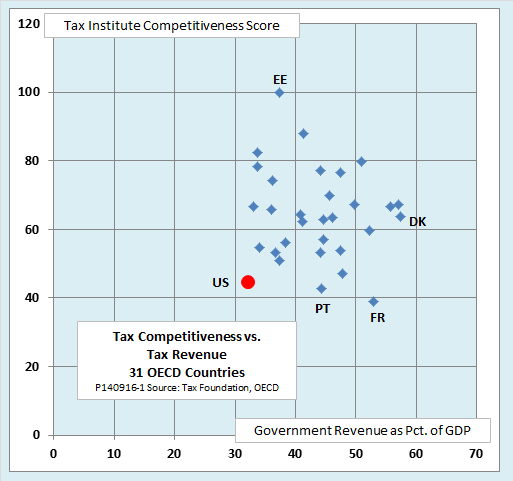
Think about it. It is not surprising that the corporate citizens of France view their country’s tax system as burdensome. After all, France has to feed a huge government sector that swallows up revenue equal to 53 percent of GDP, and still runs a budget deficit of more than 3 percent. Yet the US tax system manages to be nearly as uncompetitive as that of France while raising 40 percent less revenue.

Or compare the United States to Denmark, whose government collects the most revenue of any of its OECD peers—57.4 percent of GDP. You would think such a massive tax take would render Denmark radically uncompetitive, but instead, its Tax Institute score is 43 percent higher than that of the United States, close to the OECD average.

→ EconoMonitor

Oracle: The Worst-Governed, Best-Run Company Around

So, basically, Oracle is a horribly governed company, but it seems to be pretty well run. Which inevitably raises some questions about the true value of the standards and practices that go under the label of good governance.

***

But it’s hard to get around the reality that, so far, the company’s frequent disdain of good-governance practices has gone hand in hand with spectacular, sustained success. It could be that Larry Ellison knows a few things that the governance watchdogs don’t.

→ Harvard Business Review