
Physics, properly understood, is not a subject taught at schools and university departments; it is a certain way of understanding how processes happen in the world. When Aristotle wrote his Physics in the fourth century B.C., he wasn’t describing an academic discipline, but a mode of philosophy: a way of thinking about nature. You might imagine that’s just an archaic usage, but it’s not. When physicists speak today (as they often do) about the “physics” of the problem, they mean something close to what Aristotle meant: neither a bare mathematical formalism nor a mere narrative, but a way of deriving process from fundamental principles.
Category: Science
The Rise Of Autism

A recent study in JAMAPaediatrics, a science journal, calculated that the lifetime cost of supporting an American with autism was $1.4m-2.4m. Paul Leigh of the University of California at Davis and Juan Du of Old Dominion University have added up not only the cost of care but also the opportunity costs of autism in America. They include an estimate of the output lost when autistic people are jobless or underemployed, and when their relatives cut back on working hours to look after them. They put the total at $162 billion-367 billion in 2015, the equivalent of 0.9-2% of GDP, on a par with both diabetes and strokes. By 2025 the figure could exceed $1 trillion, they predict. Confronting autism is costly, but failing to do so may cost even more.
In Defense Of The Gaussian Copula
The Gaussian copula is not an economic model, but it has been similarly misused and is similarly demonised. In broad terms, the Gaussian copula is a formula to map the approximate correlation between two variables. In the financial world it was used to express the relationship between two assets in a simple form. This was foolish. Even the relationship between debt and equity changes with the market conditions. Often it has a negative correlation, but other times it can be positive.
That does not mean it was useless. The Gaussian copula provided a convienent way to describe a relationship that held under particular conditions. But it was fed data that reflected a period when housing prices were not correlated to the extent that they turned out to be when the housing bubble popped. You can have the most complicated and complete model in the world to explain asset correlation, but if you calibrate it assuming housing prices won’t fall on a national level, the model cannot hedge you against that happening.
Can An Artist Ever Really Own A Colour?
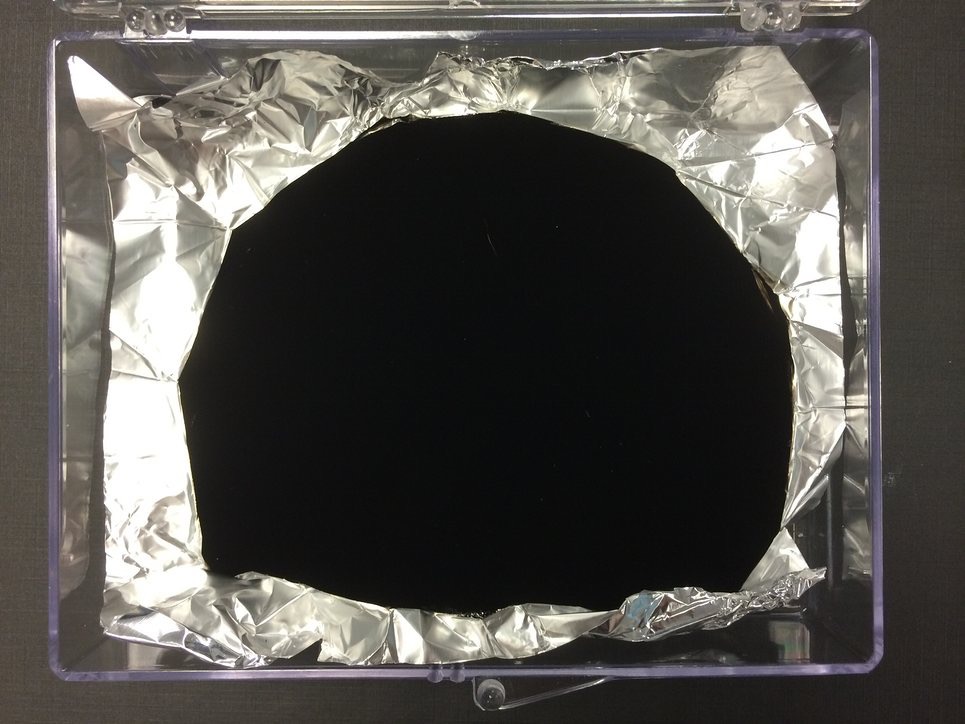
Long before Klein created IKB, painters and their patrons paid through the nose for the rarest of pigments, lapis lazuli. This mineral that creates the colour ultramarine has only ever been found in Afghanistan. In the middle ages, it was mined there and traded at enormous prices to create European images of the blue heavens. Gold leaf was then daubed on it to make stars.
Colour is magical, colour is divine – you can’t blame Anish Kapoor or his critics for going mad for Vantablack.
Reign of the Algorithm
Writers, remember: the more we play the algorithmic game, the more the algorithmic game plays us. (All hail the great Algorithm in the Cloud!)
Algorithm-oriented content is becoming ubiquitous. It doesn’t matter what you read or what topics you search for, a growing percentage of online material is designed ground-up for the acquisition of ‘Likes’ and the courtship of search engines. Food, politics, current affairs, cats, academia — everything. It doesn’t matter what you are interested in, there is an army of people writing about it with strategic intent to leverage the algorithmic landscape for their advantage.
 Abnormal Capitalist