It’s ugly 

New lows :

The fact that APB has positioned itself as protecting users from ads, only to then say it’s going to allow ads it deems acceptable to those who pay for it, has caused real shock. “Amazing how the goalposts keep changing for their users, whilst publishers are indiscriminately targeted. It turns out Adblock Plus actually want to serve you more ads not less. True colors revealed.”

• • •

“They’re allowing users to block ads, and then on the other side basically taking a cut from publishers to allow ads to run on the site even though they are the ones blocking the ads. It will be interesting to hear how much of a cut all three parties are taking, and how they are actually in the mix,” she said.

→ Digiday

What Tech’s Unicorn Cult Can Learn from the Art World

The art world knows about prices floating ever higher on abstraction and hope. The resonances aren’t completely coincidental. Both venture capitalists and art buyers are in the business of valuing the invaluable. Both stake their reputations on exquisite selection. Both nurture talent before it can support itself. Both have a soft spot for youth, for unbowed ego, for the myth of solitary genius, for the next new thing. Both operate in a world of frustratingly limited information and maddeningly unpredictable success. Both depend on consumer culture while holding themselves superior to it. And both the art market and venture investing have become increasingly winner-take-all games, with more clout to the companies and artists backed by the most powerful dealers or venture capitalists.

Credit : Harold Cunningham

→ The New Yorker


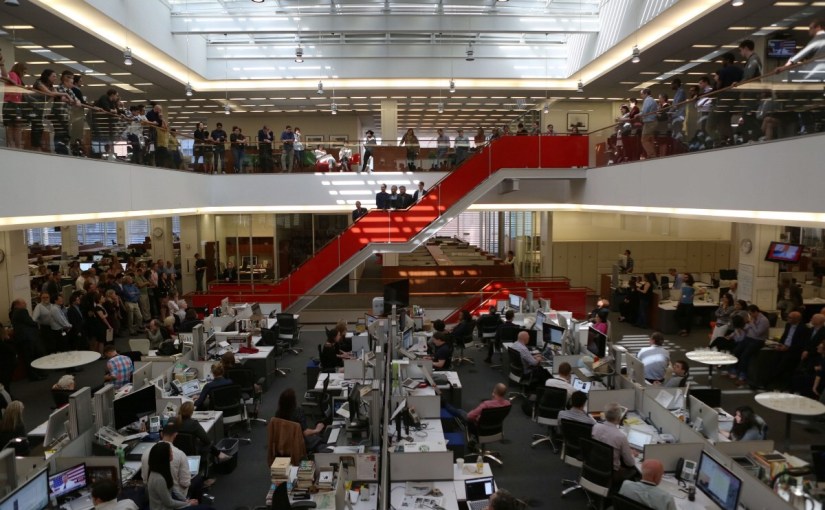
Why People Pay To Read The New York Times

In the United States, the ranks of journalists keep shrinking. As I travel around the world for The New York Times, I hear from journalists everywhere about the painful downsizing happening across the industry. This has meant important stories go untold. Costly investigative reporting units pare back their ambition in the face of budget cuts. Expensive trips to conflict zones suddenly seem like a luxury publishers cannot afford, and news organizations everywhere rely more and more on wire services to cover the world. This has reduced the vibrancy and diversity of the journalism we consume, and the world is poorer for it. Above all, local journalism has suffered. Cities that once supported two or more daily newspapers find themselves with one, or none at all.

→ Medium

Big Data’s Mathematical Mysteries

At a dinner I attended some years ago, the distinguished differential geometer Eugenio Calabi volunteered to me his tongue-in-cheek distinction between pure and applied mathematicians. A pure mathematician, when stuck on the problem under study, often decides to narrow the problem further and so avoid the obstruction. An applied mathematician interprets being stuck as an indication that it is time to learn more mathematics and find better tools.

I have always loved this point of view; it explains how applied mathematicians will always need to make use of the new concepts and structures that are constantly being developed in more foundational mathematics. This is particularly evident today in the ongoing effort to understand “big data” — data sets that are too large or complex to be understood using traditional data-processing techniques.

Our current mathematical understanding of many techniques that are central to the ongoing big-data revolution is inadequate, at best. Consider the simplest case, that of supervised learning, which has been used by companies such as Google, Facebook and Apple to create voice- or image-recognition technologies with a near-human level of accuracy. These systems start with a massive corpus of training samples — millions or billions of images or voice recordings — which are used to train a deep neural network to spot statistical regularities. As in other areas of machine learning, the hope is that computers can churn through enough data to “learn” the task: Instead of being programmed with the detailed steps necessary for the decision process, the computers follow algorithms that gradually lead them to focus on the relevant patterns.

→ Quanta Magazine