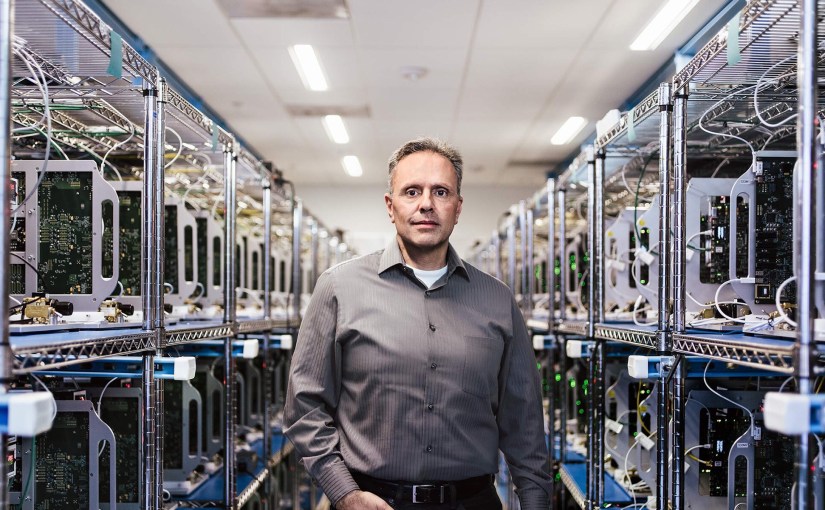
At the center of all this is Srouji, 51, an Israeli who joined Apple after jobs at Intel and IBM. He’s compact, he’s intense, and he speaks Arabic, Hebrew, and French. His English is lightly accented and, when the subject has anything to do with Apple, nonspecific bordering on koanlike. “Hard is good. Easy is a waste of time,” he says when asked about increasingly thin iPhone designs. “The chip architects at Apple are artists, the engineers are wizards,” he answers another question. He’ll elaborate a bit when the topic is general. “When designers say, ‘This is hard,’ ” he says, “my rule of thumb is if it’s not gated by physics, that means it’s hard but doable.”
Category: Tech
Growing Old, But Not Together
HP is splitting into two separate companies on the NYSE :
Founded by two tech guys in a garage in Palo Alto in 1939, the giant created by Bill Hewlett and Dave Packard is remembered as Silicon Valley’s original startup. In its heyday, its flair for innovation was unrivalled, and it devised technologies that shaped people’s work and personal lives, from calculators to cameras to computers. Today it is regarded as a has-been: a reminder of Silicon Valley’s past but not a beacon of its future.
Why Your Phone Battery Is Rubbish
What about the rest of us? Can we expect our gadgets to last longer than a day any time soon? “As long as our batteries are based on a chemical reaction, we will have huge limitations,” Buchmann says. “The health of a battery is almost like the health of a living organism or human being. We have to take care of it.” Limer says: “I don’t think things will change much in 10 years. A realistic future to hope for is one where even in extreme heavy use you can get through a day without losing your battery.” Right now, he adds, what we have is “a battery stalemate”.
Activision to Buy Candy Crush’s King for $5.9bn
John Gruber on the acquisition :
They were only going to pay $1 billion, but then they got stuck on a couple of levels, bought some gold bars, and, well, here they are.
More to follow later today (maybe), but as a reminder, here’s a poignant statement from an indie developer allegedly ripped off by King.com :
Congratulations! You win! I created my game CandySwipe in memory of my late mother who passed away at an early age of 62 of leukemia. I released CandySwipe in 2010 five months after she passed and I made it because she always liked these sorts of games. In fact, if you beat the full version of the android game, you will still get the message saying “…the game was made in memory of my mother, Layla…” I created this game for warmhearted people like her and to help support my family, wife and two boys 10 and 4.
I have never downloaded nor played to any of their apps, I find them dumb and unaesthetic. In light of the previous statement I could only encourage you to remove them.
Plus, I see mostly bored housewives or early teens playing Candy Crush, which makes the price of the acquisition even more insane. They are not real gamers like the core business of Activision-Blizzard, which is used to produce highly polished and immersive games. But I guess that’s where part of the money is to be made anyway and that’s sad.
The Fable Of The Unicorn
Yet in other ways Theranos evokes a central theme in today’s tech industry: start-ups which promise to disrupt lucrative businesses and become valued on the basis of fantasies about their potential, rather than present reality. Investors are so keen to get a piece of any sexy-sounding startup that they lap up entrepreneurs’ hype—and anyone who asks awkward questions risks being cut out of the funding round in favour of someone more trusting.
All this helps to explain the inflation of valuations among unlisted technology companies. Today there are 142 unicorns, more than three times as many as in 2013. Many of them are growing quickly. But in terms of reaching profitability, they are often far behind the stockmarket-listed competitors they are seeking to displace, and thus are burning through cash. Theranos, for example, is not believed to have any significant revenues or profits, yet it is valued about as highly as Quest Diagnostics, a listed laboratory company, which achieved $7.4 billion in revenues and nearly $600m in net profits in 2014.
 Abnormal Capitalist